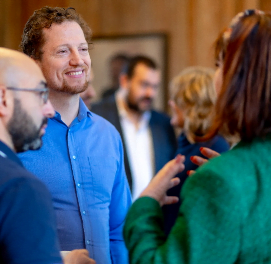
TPC Leadership develops leaders with a heart for leaders AND their organisations. They are engaged and passionate in what they do. They focus on the individual, but will always keep the vision and objectives of the organisation into account.
Janna Kramer, Learning & Talent Development Leader
EY – NETHERLANDS
Use our site switcher to easily navigate between our different offices (in your preferred language where available), or select “Global” for our head office.
In our introduction to Vertical Leadership, we talked about how developing as a leader isn’t just about adding more tools to our toolkit. It’s about increasing the capacity of that toolkit. In other words, increasing our own capacity for leadership by going on a journey to transform our mindset, attitude and understanding of the world
We also looked at how there are many parallels between the way leaders – and indeed all adults – develop and how children develop. The work of Swiss psychologist Jean Piaget in the 1930s describes how from birth a child not only learns to walk, talk and carry out physical activities but to think, understand, perceive, rationalise and make sense of the world around them.
Vertical adult development, which informs vertical leadership practice, has been studied by a number of experts over the years, who have created similar models to try and explain the patterns they have identified.
Lawrence Kohlberg and Carol Gilligan identified specific stages in moral development, for example, while Clare W. Graves and Don Beck focus on the development of culture and values. Bill Torbert looked at the way leaders make meaning of themselves, integrate diverse perspectives and process ambiguity and complexity.
The Leadership Development Framework
Taking adult development into the leadership arena, we come to the Leadership Development Framework, created by David Rooke. This helps leaders to map and make sense of the implicit ‘logics’ and assumptions that might underpin their actions and decision-making in increasingly complex business scenarios.
For example, at the earlier stages of development we may operate as leaders from our Opportunist action logic. This is characterised by a focus on our own interests and needs, and on enforcing personal power and authority. It includes asking for loyalty, sometimes instilling fear and manipulating relationships, and seizing new opportunities as they arise.
While this way of operating may provide some strong centralised leadership in chaotic and unpredictable scenarios, it is often too present – and leader-focussed – to create an environment where people feel really acknowledged and safe. Most adults outgrow this stage of development after adolescence, but we all have experienced it in our youth, for example in our early efforts to climb the ‘dominance hierarchy’ in our high school peer groups.
As we develop as people and leaders, in our way of relating to ourselves and others, we may experience new action logics emerging in our way of thinking, feeling and behaving.
The journey to achieving
At a Diplomat stage we might have experienced an increasing need to fit in, to belong, to please the ones in positions of power or authority in our organization and to loyally serve the aims of our group. We may remember these feelings as young professionals or supervisors, when we entered a new organization and had to learn to fit in and comply with the written and unwritten rules of that system in order to belong and succeed.
Diplomat leaders, unlike Opportunists, provide teams with a sense of personal connection and harmony, mutual support and attention, which fosters a real team spirit.
While at this stage dealing with conflicts may be a challenge, later stage leaders show an increased capacity to focus on craft logic and technical expertise to foster rational efficiency and process improvement (Expert). Then comes a growing capability to focus on goals and key performance indicators to prioritize initiatives and decisions in dynamic scenarios while energising their teams to achieve challenging and motivating results (Achiever).
Many organisations aim to develop and employ Achiever leaders in key positions given their capacity to generate results while focusing on forecasting, measuring and controlling. This way of operating is widely (meaning: conventionally) considered the pinnacle of adult development. Most business schools and management training focus on supporting leaders to fully integrate the dynamism, flexibility, direction and relational skills that come with consolidating our Achiever action logic.
Post conventional leadership for complex environments
But in the modern business environment, predicting, controlling and focussing on yearly and quarterly targets might not be enough to cope with the increasing complexities of the network economy or the unpredictable directions opened up by digital disruption and exponential business models.
We experience everywhere, in fact, an increasing demand for leaders capable of thinking out-of-the-box, transforming business models and cultures, engaging wide networks of stakeholders, experimenting in cooperative partnerships and focusing on shared value for shareholders, people and society.
It is exactly in these environments that leaders operating with post-conventional action logics seem to find their best fit. In fact, as leaders grow wisdom and mastery in operating within conventional business structures, they may start to develop an increasing need to critically think about the core assumptions that drive business, strategy and culture.
Post conventional leaders demonstrate a unique capacity to identify the social constructs and beliefs which limit business innovation and organisational creativity and to actively question them in order to generate innovative solutions.
Individualist leaders, for example, demonstrate great skill in adapting their communication style to engage people operating at different action logics. At the same time, they are acutely aware of the potential conflicts between a company (and leaders!) values and practices. They address the tension caused by these gaps to create innovative solutions to translate strategy into actual behaviours and performance.
Leaders operating primarily at a Strategist action logic add to this a new level of mastery in managing change, and in envisioning and implementing wider business transformation programmes. Their capacity to courageously exercise power, foster mutual inquiry, show vulnerability, and hold the tension between the short and the long term make them a rare and valuable resource in organizations where innovation, creativity, complexity processing and purpose-and-value focus are key to success.
Leadership development for the future
Frederic Laloux’s ‘Reinventing Organisations’(2014) provides a fascinating tapestry of how organisations inspired by Strategist-like leaders are daring to move beyond conventional business structures. He cites examples like AES, BSO/Origin, Buurtzorg, FAVI and Morning Star.
These businesses can outperform traditional corporations by leveraging on self-management and decentralised decision-making. On breaking the boundaries between personal and professional selves in their cultures. And on focussing the leaders’ role on coaching self-managed teams and supporting inquiry-based practices. Through this, the company’s purpose can emerge and be articulated as core criteria for business decisions.
It is important that as leaders we look back to see where we have come from and to integrate what we have learned at each stage of our development. But we must also look forward to seeing where we have the capacity to grow in our understanding of ourselves, the way we relate to others and the way we operate and make decisions in increasingly complex scenarios. The frameworks discussed in this article are a starting point for that exploration that is required on the journey towards transformation.
This is the second in a series of five articles on Vertical Leadership. To find our more, please get in touch.
@copyright TPCL
Understanding the behaviours and insights that stand the test of time By Deva Param, TPCL SEA (South East Asia)
I’m reminded of Adam Smith (the famous Scottish economist who wrote The Wealth of Nations) because in October 2019, I was invited by my alma mater, Heriot Watt University, for a speaker series at their newly-renovated Panmure House. There was an impressive lineup of speakers, alumni, students and guests at this magnificent facility which the university had recently purchased. It so happened that Panmure House was also the abode of Adam Smith who lived there between 1778 and 1790. His landmark book was the vehicle through which he shared his well-known concept of The Invisible Hand.
Economic theories and leadership drive
Over the years, many have praised Smith for his findings and The Invisible Hand (and the economic concept that marries the unintended social benefit and public good brought about by individuals who act in their own self-interest). But what dawned on me is that, while we can dwell on the economic theories, much of this would only work if there exists strong leadership in both the private and public sectors.
Why is this the case?
1. A combination of economic theories and leadership drive is very much needed for the economy to develop and for the wealth of nations to be realised.
2. There are similarities in the leadership initiatives implemented in both the public and private sectors that can be leveraged. But what might some of these similarities look like? Would it call for a certain drive? What might be needed to deal with sustainable implementation of various policies and initiatives?
Much like basic economies, organizational life contains many influencing forces that largely reflect human nature. These forces help people to identify their equilibrium on two simple principles i.e. the motivation to perform and the opportunity to perform.
The motivation to perform
Let’s look at the motivation to perform. As a leader, if you offer an individual financial reward, praise and incentives for certain behaviours, you direct their investment of time and talent towards your goals.
If you, however, fail to provide this clarity and your organization is void of sufficient structural support, it would be left to other forces to determine how an individual invests their time and effort.
The opportunity to perform
A good work environment does not necessarily mean that it’s an easy and comfortable workplace which breeds complacency and leads to a culture of mediocrity. When a performance-based culture is embraced, performance levels necessarily increase. Individuals who are passionate about contributing their talent can then obtain the support they need and work in an inspiring environment. Failing which, most high potential talent would move to greener pastures. They would do this to get the opportunity to perform at a
higher level in order to meet their aspirations. In most public sectors, the concept of lifelong employment exists. This is why the public
sector is called upon to review their policies. They need to pay special attention to policies that relate to performance and the notion of providing ‘employment for life’ regardless of the level of performance of its people.
Circling back to the theory of The Invisible Hand, it calls for leadership that is imbued with intent and design. More importantly, it requires leaders to take charge and constantly redefine their roles. This, in turn, requires execution and delegation down to the lowest possible levels within an organization.
We see that leaders are still very much at the front-line, delegating only about 20 percent of their decisions. It appears that it requires far more trust for leaders to move that empowerment percentage upwards.
That said, there are other aspects of leadership that pass the test of time. Balancing the People / Quality / Sustainability / Profits elements in their organization has always been a juggling act for leaders. They work hard to keep a watchful eye on all the “balls” in the air without dropping any of them. As leaders, we want our people to channel all of their energy into this delicate balance. We want our people to have the wherewithal to manage both the internal and external factors of day to day leadership delivery.
Constants in leadership
In all my years facilitating leadership programs and engaging with leaders at multiple points, certain trends in leadership have been constant. They have served many leaders in global organizations well. This is what I have compiled:
Courageous leadership matters.
It’s an age-old philosophy but the simple things like constantly looking for solutions and championing them matter. Even when it could mean a 50 percent chance of failure, it matters when it is something that you strongly believe in. Great leaders always ask themselves: If I fail after trying, what are those consequences as compared to the consequences if I don’t try?
Continuously engage. Do not leave a vacuum.
Leaders raise their hands and speak up even if it means that their ideas may go against groupthink.
If your ideas are good and receive positive feedback, then all will be well. If not, you would have at least tried. When you are courageous and speak up, you gain confidence. This confidence (and respect) will hold you in good stead as you climb the corporate ladder.
Choose between the fixed vs growth mindset.
Successful leaders have extraordinary tenacity. They are able to extract something worthwhile from their exploits and circumstances. They also seek the kind of experiences that provide rich opportunities for growth. If you want to become a better leader, seek worthwhile challenges and maximise all that you can from any leadership situation or opportunity.
Embrace servant leadership.
As the phrase indicates, the goal here is for the leader to serve. It is different from traditional leadership where the leader is focused on ensuring the company thrives. Is it a radical idea? Yes, it turns the traditional notion completely on its head. But that is
simply because servant leaders are all about changing the mindset. From commanding to serving. From flaunting power and authority to displaying empathy, humility and active listening. Don’t climb the leadership ladder in order to be served. Serve others, and in doing so, others will serve you even better.
Embody the 3Vs of Vision, Vitality and Voice.
Vision – Envision where you would like to bring your organization, your team and yourself. Have a clear picture in your mind of what this looks like. Then, communicate the vision clearly.
Vitality – Be positive and energised. Seek to influence your peers and supervisors wherever possible to ensure that your vision is materialised.
Voice – Give every member of your team a voice. Empower, delegate, coach and teach. Provide them with the tools they need. Track team performance. Ask yourself: What do I need to do to make a difference? How can I create visible action plans for them?
Manage people with your heart (emotion) and not with your brains (head).
Ask yourself “Why” at least five times before deciding on an issue when it involves people. They are there for a reason. Leaders need to consider this and the varied motivations at play.
Create opportunities to get feedback.
It may be difficult for leaders to get relevant feedback, particularly if they occupy powerful positions in organizations. But, in reality, leaders require more feedback than subordinates. If they do not get feedback on how they are doing, leaders may not learn much. Start by asking the team for their perception of the leader’s behaviour and the impact it has had on them.
Take a 10 percent stretch.
The stretch goal is often seen as the source of individual and organizational motivation. This differs from the ordinary challenge because there is an element of the extreme within. Leaders, I believe, need to stretch their targets by at least 10 percent from their previous targets. There are several positive outcomes associated with leaders who regularly practice the 10 percent stretch. First, their apprehension about doing something new or different gradually decreases. Second, their repertoire of leadership skills begins to broaden. Third, their team benefits from these changes.
Learn from others
Learn by asking questions and paying attention to everyday details. Ask for insights from other leaders especially if they have gone through some of the tasks you are currently undertaking. You can benefit from their experience.
Observe their insights not only in terms of how things were executed but also, about how leadership skills were employed.
Understand your superiors.
Work to understand your superior’s personal and business objectives. Much like you can help your subordinates to achieve their goals, you too can help achieve your superior’s goals (if you know what these are). Understanding your superior’s values, preferences and personality can also help you strengthen your relationship with them. The business and the team are almost always top priorities for leaders. Leaders focus their time and energy on taking care of business and then, on taking care of the team that carries out the vision. Invariably, great leaders put themselves last. It is only once their key priorities are met that they look within at their personal agenda and their own development needs. Can a leader provide opportunity for growth, innovation and creativity while also focusing on an alignment of corporate and individual goals? It is no easy feat but with practice, passion and a desire to leverage combined insight, it is something leaders can indeed aspire to.
Stay authentic.
Lastly, remember to stay authentic as there is only one of you in this world.
In conclusion, as leaders, we are called to constantly reassess our values and the business agenda. We understand that values, ultimately, are like rubber bands. They can only stretch so much until they achieve a breaking point.
This requires us, then, to ask ourselves certain questions regularly:
● What is my own personal leadership philosophy?
● What does this philosophy look like?
● What are the key elements of this philosophy?
● How do I change over time?
Everyone needs to have their own leadership philosophy. The questions above can assist you in ensuring mindfulness about your direction and values at all times.
Feel free to engage with the author or continue the dialogue here.
@Copyright TPCL (2021)
It’s a long way to the top, and there are many opportunities to discard the essential elements of ourselves along the way. The challenge is to keep growing and developing without becoming something we are not. In the 1930s Marion Milner wrote A Life of One’s Own, a powerful work about identity, identifying what’s important to you and remaining true to yourself. It’s a book that is still relevant nearly 90 years later and offers us a guide on how to keep growing without losing ourselves.
Understand why you are validated – or not
“I discovered that I was drifting without rudder or compass, swept in all directions by influence from custom, tradition, fashion, swayed by standards uncritically accepted from my friends, my family, my countrymen, my ancestors.” – Marion Milner, A Life of One’s Own
Everyone likes to be validated in what they do. When others celebrate us we may feel successful. When they disapprove, we might feel belittled. If we keep failing to receive validation for our leadership attempts, our self-confidence can be damaged and we become less likely to take risks and grow.
The challenge is that validation often depends on our conformity to the cultural norms of an organisation. If the organisation assumes leadership should adhere to a particular style, they will overlook the merits of people that can’t be squeezed into that mould.
In this situation, a leader that doesn’t conform to senior-level norms will either be discouraged out of growth, or will put aside a key part of themselves to score promotion. As Milner writes, we run the risk of simply drifting “into accepting one’s wants ready-made from other people”. This identity cycle must be broken.
Engage in introspection
“…instead of trying to force myself into doing what I imagined I ought to do I began to enquire into what I was doing. I little knew what this apparently simple act of trying to be aware of my own experience would involve me in.” – Marion Milner, A Life of One’s Own
Marion Milner discovered that there were two opposing attitudes a person could adopt to face their problems: “One, to try and change the external world, the other, to try to change oneself.”
Successful growth must begin from the inside, but where do we draw the line between changing ourselves to fit into an organisation’s culture, and changing our mindsets to become the best versions of ourselves? If our underlying goal is validation from those higher up the hierarchy, our desire to grow will be subtly skewed to their values – even if they are different to our own.
This confusion can make the difference between growing and finding ourselves, or advancing but losing ourselves and what’s important to us. Marion Milner expressed this frustration in her search, “Was there not a way by which each person could find out for himself what he was like, not by reading what other people thought he ought to be, but directly, as directly as knowing the sky is blue…?”
An obvious remedy is to continually ask questions and engage in self-reflection. To keep sweeping layers of dust off our thinking, to sift through the values that lie under our surface, gradually excavating the leader in us that is undaunted and free.
Grow in self-belief, not just confidence
“Were these reliable guides for one’s life? I could not assume that they were, for everywhere around me I saw old ways of doing things breaking down and proving inadequate.” – Marion Milner, A Life of One’s Own
Another factor that can confuse the growth process is the difference between confidence and self-belief. Confidence comes from the acquisition of skills, knowledge and expertise. The world places a premium on it and as a result it is possible to climb the career ladder and achieve a measure of success without ever examining our identity.
Self-belief, on the other hand, comes directly from a strong sense of identity – a combination of values, history, relational experience, personal agency, and all you appreciate in yourself. It cannot be acquired without self-reflection, and it is usually not disrupted by a person’s environment. Building self-belief enables us to navigate storms, anchored to our values, steady in our own sense of purpose.
As we embark on a journey of growth, it is ultimately our values, purpose and self-belief that will determine whether we become more of ourselves, or if we deviate to what others want us to be. There is little point in climbing to the top just to have an identity crisis at the summit. Likewise, it is fruitless to stay locked in organisational habits that require you to repress yourself in a certain way to receive validation. As for the way ahead, a good place to start is by daring to look beneath the surface of yourself.
Want more insight on how to move forward? Get in touch with us to find out how we can help.
Life is unpredictable. We never quite know what’s going to happen to us, even with the best laid plans. There are so many factors involved, so many unknowns. When you’re sailing out to sea, you might wish you could control the ocean. It would certainly make things easier. You wouldn’t have to worry about shipwrecks or getting lost in a storm. The wind could keep blowing at a steady pace and you could be sure the vessel under your feet stays under your feet.
“No wind serves him who addresses his voyage to no certain port.” – Michel de Montaigne
The desire to control what is going to happen to us can dominate our lives but it is impossible to control the ocean. If our aim is security, to keep the ship afloat, this might sound demoralising. But if we are set on a destination beyond the horizon and our focus is on controlling ourselves instead of our environment, the perils of the journey become part of the adventure of life.
A reason to rise above
“To put it still more plainly: the desire for security and the feeling of insecurity are the same thing. To hold your breath is to lose your breath. A society based on the quest for security is nothing but a breath-retention contest in which everyone is as taut as a drum and as purple as a beet.” – Ron Heifetz
It is so easy to get swept along by life because there are so many things that happen to us. In the day-to-day, life can feel like a series of reactions to events. It can be overwhelming. When we live by broad brushstrokes of, ‘I want to be happy,’ ‘I want to get through the day,’ ‘I want to stop everything from falling apart,’ we will find all three of these things to be difficult.
Purpose puts circumstance into perspective. When we know ourselves well enough to understand what is important to us, we can see past the immediate. When we are aware enough to perceive when our reactions are out of line with our values, we can begin to work on the underlying issues. If there’s no reason to press into what is uncomfortable, we will stay imprisoned within our default patterns of behaviour. Purpose gives us a reason to take command of the ship, to strain at the oars and sail through the wind.
Part of a crew
When we know the direction our inner compass is pointing, it doesn’t mean we have full certainty of the final destination. But we know we’re headed towards what matters to us – and we can ally ourselves with those who are also headed that way. Purpose takes you beyond yourself and into a community who have cause to stay connected. The desire to have fun can lead to good friendships but the longing to do something that matters builds belonging into people.
Where is happiness?
“Our history is a mixture of noble ideals never completely fulfilled, but always sought; and when lost track of for whatever reason, they are pursued again with renewed vigour.” – John Pepper, What Really Matters
An avoidance of difficulty is an avoidance of life. Living fully means embracing the risk, the unknown, the failure. It means going to your edge. You might not expect to find happiness there but that is where fulfilment happens, where legacies are left, where the extraordinary occurs. Happiness doesn’t just make an appearance on the shores of your destination. It’s as part of a crew. Journeying towards the horizon.