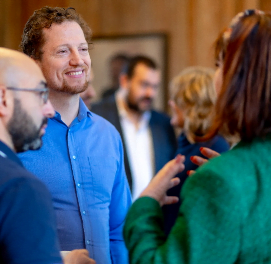
TPC Leadership develops leaders with a heart for leaders AND their organisations. They are engaged and passionate in what they do. They focus on the individual, but will always keep the vision and objectives of the organisation into account.
Janna Kramer, Learning & Talent Development Leader
EY – NETHERLANDS
Use our site switcher to easily navigate between our different offices (in your preferred language where available), or select “Global” for our head office.
In the final blog of our Leading with Meaning and Purpose series TPC Leadership partners, Andrew McDowell and Hilary Harvey discuss systems leadership and how to create meaning and purpose for the whole system.
Systems leadership
We create leadership structures with the aim of optimising performance, creativity and communication, but many organisations overlook how both meaning and purpose fit into the equation.
Andrew McDowell, a Partner at TPC Leadership, sheds light on the matter. “Great systems leaders help people understand where their roles contribute to a shared purpose, and they also create opportunities for people to make meaning from what they are doing together.”
We have explored how both meaning and purpose are essential qualities in our personal leadership, our relational leadership and our team leadership. And all of these levels of influence affect our systems. But what else can we do?
Meaning in the mechanisms
Organisations are always in motion, but our systems have the power to make that movement feel either like mere activity or meaningful progress. Systems leadership often involves helping people realise how far they have come, and where they’re going and what they are contributing to.
“It’s not just about ‘my role’ anymore,” says Andrew, “it’s about the overall system and how I’m impacting it.” He recalls a time when he worked with the top 300 senior leaders in a large organisation. “When they had the opportunity to see how they and their team were one part of the mechanism that contributed to the collective activity of others and an overall purpose, they were much more likely to engage and enthuse their teams to that end.”
No one wants to feel that their work is just about keeping cogs turning, they want to see the how the cogs fit into larger cogs, the engine whirring, the ground passing quickly beneath them towards a destination and the horizon drawing closer.
Andrew explains that good systems leadership is about “creating opportunities to celebrate people’s success, to share their achievements, and to have opportunities for further development.” But it’s also, he adds, “about engaging differently with stakeholders and beneficiaries of whatever that work is.”
More than ethics
In most companies, there’s an emerging consciousness around the importance of sustainability and making a larger difference through what they are doing that extends just beyond the immediate goals of the organisation and stockholder value. Progressive businesses are looking at developing meaningful alignment with more globally oriented initiatives like the Sustainable Development Goals (SDGs). It’s more than contributing to a charitable cause. It’s more than mitigating the impact of profit-making with a few ethical considerations.
Through alignment to the SDGs, companies have the opportunity to align their strategies and operations with universal principles on human rights, anti-corruption, labour and environment; infusing their companies with ideals and actions that advance societal goals. It’s about showing everyone across the system that they are moving the needle of how they operate as an organisation and how they are collectively contributing to how the world could operate. “We’re at a critical point in human history,” says Hilary Harvey, Partner at TPC Leadership, “we need to be taking faster action towards achieving our Global Goals, and are running out of time to minimise the devastating effects of climate change. I feel strongly that systems leaders need to be thinking into the long term, and help their organisations and systems play their part in addressing the most important societal and environmental challenges that are part of our reality.”
If you are part of an organisation that is consciously aligning to a Sustainable Development Goal or something else that matters on a social or global level, and your leadership team is effectively communicating the intent and how you are part of something, it creates a very clear message to people that they are meaningfully contributing to a wider purpose.
The systemic impact of aligning around a purpose is not just about the feel-good factor, it has a tangible impact. For example, Ernst & Young recently published some preliminary findings indicating that companies that are “purposeful” have been shown to outperform the stock market by 42%; and that companies without a sense of purpose clearly articulated in their mission, underperform the market by 40%.
Andrew adds, “What’s interesting is that it can’t just be words on a page. Purpose-led organisations need purpose-led leaders that support people to integrate the sense of purpose into everything they do. Whether the system is infused with purpose and can people feel connected to it or not, often comes down to the quality of leadership they experience”
Looking further in every direction
So what are the obstacles? “People get stuck in silo thinking,” says Andrew. “They keep their heads down sometimes. They focus on achieving individual goals, or reaching KPIs or delivering their part of the business’s required contribution. But they miss the bigger picture.”
“Systems leadership requires people to look up, to look across and to look through,” says Andrew. “You can only appreciate that the whole is greater than the sum of its parts when the whole is made more visible. A musician only understands the importance of the score before them when they have an appreciation of the entire orchestra”.
While it’s obvious that leaders need to adopt a systems view; it’s less obvious that there is tremendous advantage in helping other people see the bigger picture and the wider purpose. Our structures need to give people a vantage point so that they can see it too. Otherwise, it’s very challenging to keep playing your note effectively if you don’t understand how it contributes to the overall music being produced. But when the purpose is clear, and people understand their role in contributing to it, meaning can be felt across the entire system. Every member of the orchestra finds their swing. And you’ll have a hard time telling anyone to stop.
“Consider the system leader of the orchestra – the conductor,” says Hilary, “it’s their responsibility to help each and every musician stay aligned to the purpose of the piece which is to convey a particular message from the composer. The conductor needs to guide the musicians in the different instrument sections to work together harmoniously both within their section in combination with other sections. They work proactively with the section leaders to build this alignment and trust them to create this within their teams. To make matters even more complex, the best conductors encourage creativity and interpretation at an individual level and blend this seamlessly to create a collective experience that is incredibly powerful, both for the musicians as well as the audience. Imagine if our systems leaders were able to learn to do this within their own organisations, creating a powerful sense of meaning and purpose both for clients as well as employees.”
Want more insight on how to move forward?Get in touch with us to find out how we can help.
Having belief and purpose
“It is extremely powerful… just simply to have the courage of saying, you know your stuff go and do it”.
In this episode of The Leadership Sessions, Tom Van Dyck and Mercedes Alonso discuss the challenges and benefits of diversity, the meaning of authentic leadership and the opportunity of having the patience to let different opinions and different experiences influence decision making.
The Leadership Sessions is a podcast series of captivating conversations with exceptional leaders from around the world sharing their insights, experiences, thoughts, and personal opinions about what leadership means and what it takes to be effective.
Tom Van Dyck, Senior Partner at TPC Leadership
Mercedes Alonso, Executive Vice President Renewable Polymers and Chemical s at Neste.
TPC Leadership is a dynamic global partnership specialising in leadership solutions that deliver cultural transformation and financial impact. With offices around the world, covering 100+ countries, a network of 350+ partners, consultants and associates from diverse professional and cultural backgrounds, TPC Leadership delivers transformational leadership solutions in service of people and business results.
Neste, based in Finland, is the world’s leading producer of sustainable aviation fuel and renewable diesel, and works on solutions for the chemicals and polymers industry to address global issues, such as plastic waste, pollution and climate change.
On your personal take on leadership:
”leadership is truly about people about the teams that you have”
“It is extremely powerful… just simply to have the courage of saying, you know your stuff go and do it, if you need something, I’m here to help”
On authentic leadership:
“…if I, as a leader, have that belief and the purpose and you take it seriously, and everything we do is guided by that purpose… that’s showing authentic leadership.”
“the people, when they are so engaged, when they see that they are doing something with meaning and purpose that their leadership also see them as people and not just as employees, then they give the best…”
On diversity:
“when you have so much diversity, what you have is as well as an enormous richness of different opinions and different experiences. And they do not always converge… so it requires a much more active style of leadership…”
“we want to hire a balanced approach but what we see is that then we attract a lot more of different talent. People that do believe in diversity people, that see that they don’t need to fight for equality because it’s obvious”
“we have a lot of fun working together, we cherish these kinds of different ideas and hearing what the others have seen in their careers or what they think”
“using that diverse team to understand where we’re going in the business, I truly think that that’s what is making the difference”
On what you would say to your 25 year-old self:
“enjoy what you have, exploit it, and then just listen to yourself”
If you wish to share comments or a specific topic that you would like us to cover in a podcast, drop us a line on [email protected]
By Andrea Cardillo, Managing Partner TPCL Italy
Every good leader knows that there’s room for improvement. There are new skills to learn, new information to assimilate, new methods to master. But too often we get stuck in horizontal development, adding ever more tools and ideas in our leadership toolbox without radically changing the way we think about leadership.
While it is totally acceptable to develop our own knowledge and skills – in fact, it’s an essential part of a leadership role – this should always be complemented by vertical development focus and practices. This is a more fundamental, internal and transformational development journey aiming to engage, at a deep level, the leader’s mindset, attitude and understanding of their world.
Vertical development doesn’t only add more jewels into the treasure chest, it makes the treasure chest bigger and capable of holding that much more.
Becoming a more “grown-up” leader
Vertical development is a personal evolution that is similar to the way a child develops, with various stages that must be transcended and integrated.
In the 1930s, Swiss psychologist Jean Piaget described cognitive development as having four key stages. First, from birth until they are two years old, a child is going through the sensorimotor stage, ultimately learning about object permanence – the knowledge that things exist even if they can’t be seen.
Preoperational (age 2-7), concrete operational (7-11) and formal operational (adolescence to adulthood) follow, with the child developing symbolic thought, operational thought and eventually the ability to understand abstract concepts.
Note that this isn’t about the child learning to feed themselves or to walk or to write their own name. It’s more about their ability to think, understand, perceive, rationalise and make sense of the world around them.
In the same way, vertical leadership development isn’t about gaining skills. It’s about increasing your capacity to understand yourself and others and to think strategically in an increasingly complex world. It is, at a very fundamental level, about “growing up” as a leader.
Models of vertical leadership development
Just as Piaget was able to distil the cognitive development children go through into four key stages, so a variety of experts have created a number of models to help us understand vertical leadership development.
Lawrence Kohlberg and Carol Gilligan identified specific stages in moral development, Clare W. Graves and Don Beck in culture and values development, Bill Torbert in the way leaders make meaning of themselves, integrate diverse perspectives and process ambiguity and complexity.
The Leadership Development Framework, developed by David Rooke, helps leaders to map and make sense of the implicit ‘logics’ and assumptions that might underpin our actions and decision-making in increasingly complex business scenarios.
Another useful model for understanding leadership development in context is Frederic Laloux’s exploration of how organisations have evolved throughout history. He describes this in his book Reinventing Organisations(2014), which draws on previous work by the likes of Clare Graves, Robert Keigen and Ken Wilber.
For more info about these models keep an eye on the next post on the models of vertical leadership.
Common assumptions and how to avoid them
At this point, it’s important to point out that vertical leadership development isn’t about ascending through the ‘levels’ or pigeon-holing ourselves into one ‘category’. It is about expanding our capacity by exploring and integrating different action logics, which naturally operate within us. And it’s about appreciating and including the most useful and context-appropriate elements of each as we transcend them.
Most of us will find that we move up and down the list in different contexts. For example, in times of stress, people who have accessed the later stage action logics may well revert to the problem-solving Expert or results-driven Achiever.
It’s also important to remember that while there are benefits of the later stage action logics, the earlier ones are not without use. If you were ever in a street fight, for example, it would be prudent to ignore the Strategist visionary thinking in favour of the self-protective instincts of the Opportunist.
That said, there can be great advantages to integrating later-stage action logics, especially in complex, changing environments where strategic thinking is essential. At these more advanced stages of development, a leader is more capable of integrating the points of view of different stakeholders, of listening more deeply to their implicit and explicit needs, of understanding more fully how the structures and the systems around them are influencing these. As a result, they are more likely to challenge the status quo, innovate and find new solutions.
So if we assume that you want or need to inquire into and further develop through your action logics, how do you go about it?
How to grow and develop vertically as a leader
In its simplest form, vertical development is about enhancing your capacity to experience and understand yourself and others and to think systemically and strategically in an increasingly complex world. As such, it is outworked within an individual, interpersonal and institutional context.
The challenge for an individual is to understand the space you currently occupy and envision what it would look like to think, feel and act out of the box. One-to-one coaching can help facilitate this kind of personal development work in order to gain insights about yourself as a leader.
When it comes to how we relate to others, 360 feedback, action learning and team coaching may all be powerful tools for identifying and navigating interpersonal dynamics. Learning to shift our perspective to that of someone different to ourselves is an important skill for any leader who wants to get the most out of the teams he or she works with.
At a wider level, senior leadership teams can undertake wider consulting interventions to apply vertical leadership development principles across the organisation. This might take the form of the creation of a community of practice, for example, or the facilitation of disruptive thinking when dealing with business issues.
Being a successful leader is about more than adding new skills and knowledge to your toolkit. Instead, it is about developing greater capabilities for understanding yourself, others and the wider, complex environments in which you lead. Doing so allows you to move beyond incremental development and achieve a transformational quantum leap in the way you lead yourself and others as you transform your business.
This is the first in a series of five articles covering Vertical Leadership. To find out more, please get in touch.
@copyright TPCL
In our last panel discussion, we heard how TPCL Germany is shaping organisational culture and seeing breakthrough. In this article, the second in a series of three, we travel (virtually speaking) to Switzerland to hear the insights of two of TPC Leadership’s most commercially perceptive leaders.
We’re joined from Zurich by TPCL Managing Partner Reinier Labadie, along with TPCL Partner Marcus de Vasconcelos.
Reinier, a management consultant for 22 years, has a rich history working with multiple Fortune 100 companies. Marcus meanwhile, has implemented business transformation programmes for large corporations across the globe. Here they speak of the challenges they are facing and how multinational companies need to adapt to the evolving global landscape.
A partnership and an integrated perspective
“Marcus and I already go back 10 years or so,” Reinier says, speaking of how TPCL Switzerland was formed. “We had a good history of working together.”
Originally, Reinier was the consultant and Marcus, who has worked for large corporations across four continents, was the client. Their paths crossed over the years until eventually Marcus left the full-time corporate world to train as a coach. Almost inevitably, he connected with Reinier again and, eventually, became a part of TPCL.
“It’s certainly different from working in a large corporation where you have hundreds of resources and large budgets at your disposal,” Marcus says. “But also, honestly, it’s more fun because I can see the direct impact of what I do.”
Switzerland is a country of multinationals who face both a number of advantages and their fair share of challenges. The perspective of both Reinier and Marcus is a powerful combination, providing the insight that these businesses are looking for.
“I look at matters very much from a consulting perspective,” Reinier says. “While Marcus brings his corporate view. It helps us to be closer to what our clients really need. And what do they need? Business transformation is often driven by organisational and process change, but many of these larger businesses struggle in terms of people – making sure they thrive with change, resulting in increased performance.”
How to transform an organisation
This people problem is echoed by Marcus, who references how he has helped businesses adapt to significant shifts in their approach, customer base or market. He talks of strategy, systems, processes and organisation, but it is the people who present the largest challenge.
“At the end of the day,” he says, “the big challenges always come when you need to help people who have done something a certain way for years, decades sometimes, to adapt to do it differently… or to do something completely different.”
This is particularly a struggle when an organisational culture reinforces the old approach. No matter how dedicated a leader is to transformation, change will get stuck in the mud of old mindsets unless that thinking is addressed.
“If you have a new senior leader who takes a more enlightened view about leadership,” Marcus says, “the culture of the company needs to support that view, otherwise that person is not going to survive for long. If that leader persists regardless, it might actually be counterproductive for the person, both in terms of what they can do in the company and in terms of their career.”
Creating a multinational methodology
Successfully creating a culture shift is challenging in any situation, but the difficulties are heightened for multinationals based in Switzerland and with offices all over the globe.
“For those big multinationals,” says Reinier, “be it Nestlé, UBS, Novartis, Roche or one of the many others, you need to have a consistent approach. One which you can help roll out across multiple countries and multiple continents. That’s where TPCL can make an important difference.”
The TPC Leadership network, as Navin and Ulrich discovered in Germany, gives our partners access to specialists and teams of consultants across the globe. They are then able to facilitate transformation projects in different regions.
“To work with large corporations,” says Marcus, “you need to have a consistent methodology so you can replicate the approach around the world. What we have focused on, over the last year, is getting feedback from senior leaders so we can refine our methodology. Or to put it in more commercial terms, we’re developing our offering, and it’s been a really insightful learning experience.”
The challenges for remote teams
Reinier notes that, with the rise of remote working, it is becoming increasingly challenging for multinational businesses based in Switzerland to keep their teams focused on the strategic needs of the company.
“One of my clients is recruiting more remote workers from further afield,” Reinier says. “And they’re looking to fly them in once a month to maintain a sense of team cohesion. It’s a perfectly acceptable strategy but it’s asking much more from leaders in terms of keeping the team together.”
Part of the solution, Reinier says, is to ensure purposeful leadership. A strong sense of aspirational purpose will keep performance high and enable businesses to grow and thrive. Where this becomes complex is in how you instil and maintain that sense of purpose across a multinational team.
“To encourage a sustained mindset, you cannot do it by department. You need to include all the compartments of your organisation in your efforts, creating a consistent approach across each region. And this,” Reinier says, “is where TPCL comes in.”
Looking to create transformation or maintain cohesion in your organisation? Get in touch to learn more about how we can help.
The recent approval in Italy under Prime Minister Mario Draghi of the ‘National Recovery and Resilience Plan’ will determine, in the next few years, an extraordinary boost for Italy and the broader European economy. The most innovative industry sectors will be in pole position to benefit, directly and indirectly, from a Plan focusing on digitization, innovation, green revolution, ecological transition and infrastructures for sustainable mobility.
These strategic initiatives are consistent with market trends that private and public companies have been called upon to deal with in defining their future evolution:
1. Industry 4.0 and the potential of artificial intelligence, cloud manufacturing and the use of big data;
2. The diffusion of fluid job descriptions and the resulting need to close the competency gaps between demand and supply of technological and social skills;
3. The need to embrace adaptive business strategies to cope with complex, interconnected and unpredictable scenarios, and, consequently, the experimentation in the field of agile, anti-fragile and innovative organizational models that can overcome the obsession with efficiency and central control;
4. The growing demand for employee value propositions that can authentically leverage the advantages of flexible and remote work and the request for shared meaning and values in a stakeholder- and environment-oriented capitalism.
What role will the HR community be called upon to play in the next ten years within this scenario?
It is likely that HR models focused on administration and passive reaction to business requests are to remain relevant only in those (few) sectors that will not be significantly affected by these trends. Similarly, HR approaches that are excessively focused on talent evaluation and performance measurement without a clear connection to social impact and organic employee development risk losing much of their appeal for new generations and the growing community of digital nomads.
In recent years our organization has worked with HR departments and business leaders from various industrial contexts and cultural backgrounds. This experience has convinced us that the time is ripe to imagine HR not only as a business partner but as an integral part of the business in developing strategies, business models and organizational cultures that, leveraging on diffused leadership and decentralized governance, free the systems intelligence and ability to organically innovate through ongoing exchanges with customers and stakeholder communities.
If this looks like science fiction today, we should seriously ask ourselves what the alternative would be. Can Italy – like other major European countries – seize the opportunities and challenges of the coming years without learning to do differently, rather than just pushing itself to do more? Can we do this without learning to think unconventionally by leveraging the wisdom and agility of collective systems?
We believe that by bringing these questions the HR community can today play a key leadership role in orienting businesses towards the new horizons that are unfolding in front of our eyes.
If our community will be able to fully interpret this role, it will depend on our courage in listening to the tensions and needs of the present and in our capacity to co-create images of a future capable of responding to them in radical ways.
To find out more about the key challenges that Boards and Executives face, and how TPC is helping international organisations, click here Executive Topics | Leadership Development | TPC Leadership
To learn more about TPC Leadership, don’t hesitate to get in touch.
Original article By Andrea Cardillo Managing partner TPCL Italy and Christian Scholtes Managing partner TPCL Romania (@TPCL 2021)
Life is unpredictable. We never quite know what’s going to happen to us, even with the best laid plans. There are so many factors involved, so many unknowns. When you’re sailing out to sea, you might wish you could control the ocean. It would certainly make things easier. You wouldn’t have to worry about shipwrecks or getting lost in a storm. The wind could keep blowing at a steady pace and you could be sure the vessel under your feet stays under your feet.
“No wind serves him who addresses his voyage to no certain port.” – Michel de Montaigne
The desire to control what is going to happen to us can dominate our lives but it is impossible to control the ocean. If our aim is security, to keep the ship afloat, this might sound demoralising. But if we are set on a destination beyond the horizon and our focus is on controlling ourselves instead of our environment, the perils of the journey become part of the adventure of life.
A reason to rise above
“To put it still more plainly: the desire for security and the feeling of insecurity are the same thing. To hold your breath is to lose your breath. A society based on the quest for security is nothing but a breath-retention contest in which everyone is as taut as a drum and as purple as a beet.” – Ron Heifetz
It is so easy to get swept along by life because there are so many things that happen to us. In the day-to-day, life can feel like a series of reactions to events. It can be overwhelming. When we live by broad brushstrokes of, ‘I want to be happy,’ ‘I want to get through the day,’ ‘I want to stop everything from falling apart,’ we will find all three of these things to be difficult.
Purpose puts circumstance into perspective. When we know ourselves well enough to understand what is important to us, we can see past the immediate. When we are aware enough to perceive when our reactions are out of line with our values, we can begin to work on the underlying issues. If there’s no reason to press into what is uncomfortable, we will stay imprisoned within our default patterns of behaviour. Purpose gives us a reason to take command of the ship, to strain at the oars and sail through the wind.
Part of a crew
When we know the direction our inner compass is pointing, it doesn’t mean we have full certainty of the final destination. But we know we’re headed towards what matters to us – and we can ally ourselves with those who are also headed that way. Purpose takes you beyond yourself and into a community who have cause to stay connected. The desire to have fun can lead to good friendships but the longing to do something that matters builds belonging into people.
Where is happiness?
“Our history is a mixture of noble ideals never completely fulfilled, but always sought; and when lost track of for whatever reason, they are pursued again with renewed vigour.” – John Pepper, What Really Matters
An avoidance of difficulty is an avoidance of life. Living fully means embracing the risk, the unknown, the failure. It means going to your edge. You might not expect to find happiness there but that is where fulfilment happens, where legacies are left, where the extraordinary occurs. Happiness doesn’t just make an appearance on the shores of your destination. It’s as part of a crew. Journeying towards the horizon.