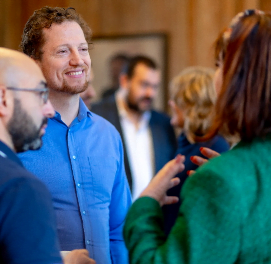
TPC Leadership develops leaders with a heart for leaders AND their organisations. They are engaged and passionate in what they do. They focus on the individual, but will always keep the vision and objectives of the organisation into account.
Janna Kramer, Learning & Talent Development Leader
EY – NETHERLANDS
Use our site switcher to easily navigate between our different offices (in your preferred language where available), or select “Global” for our head office.
The recent approval in Italy under Prime Minister Mario Draghi of the ‘National Recovery and Resilience Plan’ will determine, in the next few years, an extraordinary boost for Italy and the broader European economy. The most innovative industry sectors will be in pole position to benefit, directly and indirectly, from a Plan focusing on digitization, innovation, green revolution, ecological transition and infrastructures for sustainable mobility.
These strategic initiatives are consistent with market trends that private and public companies have been called upon to deal with in defining their future evolution:
1. Industry 4.0 and the potential of artificial intelligence, cloud manufacturing and the use of big data;
2. The diffusion of fluid job descriptions and the resulting need to close the competency gaps between demand and supply of technological and social skills;
3. The need to embrace adaptive business strategies to cope with complex, interconnected and unpredictable scenarios, and, consequently, the experimentation in the field of agile, anti-fragile and innovative organizational models that can overcome the obsession with efficiency and central control;
4. The growing demand for employee value propositions that can authentically leverage the advantages of flexible and remote work and the request for shared meaning and values in a stakeholder- and environment-oriented capitalism.
What role will the HR community be called upon to play in the next ten years within this scenario?
It is likely that HR models focused on administration and passive reaction to business requests are to remain relevant only in those (few) sectors that will not be significantly affected by these trends. Similarly, HR approaches that are excessively focused on talent evaluation and performance measurement without a clear connection to social impact and organic employee development risk losing much of their appeal for new generations and the growing community of digital nomads.
In recent years our organization has worked with HR departments and business leaders from various industrial contexts and cultural backgrounds. This experience has convinced us that the time is ripe to imagine HR not only as a business partner but as an integral part of the business in developing strategies, business models and organizational cultures that, leveraging on diffused leadership and decentralized governance, free the systems intelligence and ability to organically innovate through ongoing exchanges with customers and stakeholder communities.
If this looks like science fiction today, we should seriously ask ourselves what the alternative would be. Can Italy – like other major European countries – seize the opportunities and challenges of the coming years without learning to do differently, rather than just pushing itself to do more? Can we do this without learning to think unconventionally by leveraging the wisdom and agility of collective systems?
We believe that by bringing these questions the HR community can today play a key leadership role in orienting businesses towards the new horizons that are unfolding in front of our eyes.
If our community will be able to fully interpret this role, it will depend on our courage in listening to the tensions and needs of the present and in our capacity to co-create images of a future capable of responding to them in radical ways.
To find out more about the key challenges that Boards and Executives face, and how TPC is helping international organisations, click here Executive Topics | Leadership Development | TPC Leadership
To learn more about TPC Leadership, don’t hesitate to get in touch.
Original article By Andrea Cardillo Managing partner TPCL Italy and Christian Scholtes Managing partner TPCL Romania (@TPCL 2021)
Leading through change
Businesses have given reluctant nods to the climate crisis for a while now, often in the name of generating some good PR. And for a time, it has been enough to look like you’re doing something. But the rules to this game are shifting. And learning to truly lead through change is more important than ever.
Some businesses have already taken some positive steps; an independent report from EcoAct reveals that in the UK, FTSE 100 businesses account for 50% of the most sustainable companies. Those top businesses rated high for their reporting, measurement, strategy and innovation.Companies such as Marks and Spencer were singled out for introducing plastic-free produce and plastic take-back schemes. But despite this, EcoACT MD Stuart Lemmon still noted that“change is simply not happening fast enough.”
If that thought feels discouraging, it is because our thinking requires an upgrade. There is an opportunity right now to be part of a new wave of business, a new kind of leadership. Our response now will affect everything in years to come.
It’s a symptom of a wider problem
If some new product or initiative does not seem to advance the company’s stated values, many CEOs seek solace by distancing themselves. They rationalise that it’s really not their business to monitor how people use the products they offer to the world.” – Marc Benioff and Monica Langley, Trailblazer: The Power of Business as the Greatest Platform for Change.
However, every part of a company – its products, policies, people, its wider impact – tells a story about the health of the whole business. It’s no longer enough to only concern ourselves with the balance sheet.
Much of the Western mindset is clipped by compartmentalisation. Whether we’re making divisions between home and work life, friends and colleagues, leaders and followers – our thinking bends towards separation.
Part of the reason we have found it easy as businesses, to ignore or feel powerless about the climate crisis, is that the problem has historically been siloed. Environmental concerns belong in their own category; a category with negative connotations and an unpleasant association with bad news and negative press coverage. And anyway, aren’t there plenty of charities, activists and politicians to sort out that sort of thing? We can quickly relegate climate issues to at best a secondary priority for our business, at worst off the radar completely. There are plenty of problems in the marketplace that we can solve, and so it feels legitimate to focus on those instead.
However, if we get away from the traditional western mindset, remove the artificially imposed categories that separate climate from business, in order to look at the whole, we cannot think about our company without thinking about its impact – on its employees, on its customers and on the world it belongs to. Everything matters because we are an intrinsic part of it.
We need a new stakeholder model
“One of Google’s mantras is to ‘10x’ anything they can lay their primary-coloured hands-on, and Facebook’s internal rallying cry is to ‘move fast and break things’… the default assumption that big is good, and bigger is better, presents and ever increasing threat” – Sam Conniff Allende, Be More Pirate: How to Take on the World and Win
In Trailblazer, Marc Benioff outlines how Salesforce.com switched from a shareholder model to a stakeholder model – in which employees, customers, schools and the planet are placed alongside shareholders in their importance. The significant point is: they ended up being more successful as a result.
When we deprioritise important stakeholders in our business – whether it is the environment or something else, we will gradually lose our capacity to influence and lead. When was the last time anyone was thrilled to be a part of the Facebook community? But when we define success as success for all stakeholders, our influence will continue to grow.
Leading through change will become the norm
“Change is coming, whether you like it or not” – Greta Thunberg, leading environmental activist
The changing nature of the world demands a change to the nature of our leadership. We cannot run our companies as we did 10 years ago. We have to become responsive to the now.
If we’re going to do this in any meaningful way, it’s not enough to make some snap decisions, or add another sentence to our list of company values. That kind of change won’t last.
We have to ask better questions. To work out why we ourselves have felt powerless to leverage change. To dig deep into the operations of our businesses and discover what is working against us. To re-evaluate our culture so we can become responsive. If we do, we’ll become more successful leaders. And that success will belong to the many.
Keen to keep ahead of the winds of (climate) change? Don’t hesitate to get in touch