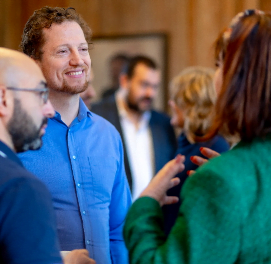
TPC Leadership develops leaders with a heart for leaders AND their organisations. They are engaged and passionate in what they do. They focus on the individual, but will always keep the vision and objectives of the organisation into account.
Janna Kramer, Learning & Talent Development Leader
EY – NETHERLANDS
Use our site switcher to easily navigate between our different offices (in your preferred language where available), or select “Global” for our head office.
The Country Leadership Team, together with the CEO of a large professional services organisation and operating in a very competitive landscape, felt they needed to better equip their Directors newly promoted to Partner, with the leadership skills required in the transition to their new level of responsibility. Although they were provided with information around roles, targets, rules, regulations, etc., they were underequipped in leadership skills as there was still a dominant culture of ‘command and control’ with expertise being recognised, rewarded and promoted, not necessarily ‘leadership’.
Objectives
To foster peer solidarity & strong bonds in a cohort of Partners in order to inspire, grow and learn from each other throughout their careers
To infuse the new Partners with a mindset of being change agents, to be the ‘new blood’ in the organisation, as explicitly required by the Country CEO
To equip all Directors, newly promoted to Partner, with the required leadership toolbox
Interventions
The programme is managed by two TPC Leadership facilitators and a number of coaches. TPCL work closely with the client’s HR and partner relations teams, who supply input and the set objectives for the programme. The continuous redesign was entrusted to TPCL. Each programme is tailored to the current client needs and is key to the programme’s success.
To date, TPCL has successfully guided and coached a large number of Partners during multiple (annual) cohorts, starting in 2018. Cohorts are purposefully kept intimate to ensure a personalised journey for the entire 12-month cycle. The cycle is launched with a kick-off and encompasses three individual coaching sessions and three times two-day (off-site) training camps.
Each training camp dives deeper into key leadership development topics, namely:
Training Camp 1: Personal Leadership,
Camp 2: Team Leadership and leading change
Camp 3: System Leadership
TPCL regularly touch base with the client throughout the cycle during feedback/feedforward sessions.
The organisation saw the value in TPCL’s unique approach to facilitating, with human-to-human interaction and sharing personal experience being central. They also accepted and understood the reason for three coaches, none being facilitators, to guide the Partners in private coaching sessions, the intimacy allowing an even more open relationship in a psychologically safer space. The Partners could comfortably discuss moments they were triggered during the facilitation sessions and in day to day situations.
Working with such a dynamic, incredibly busy group of new Partners has its challenges. Managing their mental and physical presence to ensure they could all be together in the same room for more than 15 minutes, was only overcome by mutual commitment and trust in the process. Partners were eager to continue the programme remotely, following the long interruption created by Covid-19, highlighting the value the Partners had felt being together, despite the hurdles. In the session on Team Leadership, TPCL facilitators act as team coaches, observing the cohort, assessing the Partners working on a real project driven by the country leadership team. The facilitators are able to share their observations at the end of the real play session. The session on Systemic Leadership takes place directly after their annual meeting with all Partners. They had received pre-work observation questions to encourage them to observe and analyse their own system within the bigger organisation which serves as valued real-life input for their training.
Outcomes
The annual programmes, each spanning over 12 months, allows TPCL to form close relationships with the Partners. They are transformed individually, their perceptions of the new roles changed in positive ways. It became transparent to each of them in mind-shifting ‘A-ha’ moments that a Partner is not just a super director but leads teams and has to inspire and engage people. The confidence in and success of the leadership programme has allowed TPCL to return to the client year after year, offering training which is in fact an accompanied walk – the metaphor used by our client is one of mountaineering: base camp is the kick-off, training camps are the three modules – TPC Leadership were the Sherpa.
“The sessions were a great experience and have definitely delivered a lot of food for thought. I definitely think we should maintain this format for future cohorts.” feedback from a participant and Partner.
To learn more about this case or other interventions of relevance for your organisation don’t hesitate to get in touch.
Start thinking about leadership structures
It’s an oft-repeated maxim that leaders create other leaders. But without the right structure in place, you might wonder why it doesn’t seem to work.
Structure drives behaviour. If you are not intentional about the former, you will not be able to shape the latter. Too often, in a rush to create results, we focus on symptoms rather than the underlying causes. Next to organisational culture, organisational structure is one of the most significant influencers of them all.
The pathway defines the traveller
On what basis are people promoted in your organisation? Is it because they have displayed initiative or because they have been loyal? Because they have been innovative or because they have mastered the status quo? The way we review people will determine who they want to become.
It is not the fault of the builder if the architect has supplied flawed blueprints. Our promotion and reward system maps out a route for those in our organisation to follow. If the route to the top is fraught with caution and loyalty, we can hardly expect them to suddenly develop a taste for risk-taking and originality once they get there. The pathway to responsibility determines the quality of the people who will eventually take hold of it.
The entrypoint affects the endpoint
It is common to recruit people based upon their technical skills and expertise, but at the hiring stage we often undervalue emotional intelligence. And this has more impact than we realise. Later, when we want to develop these individuals into leaders, they won’t suddenly develop social skills or the ability to inspire others. We end up with many specialists but few leaders.
Our preoccupation with hard skills and hard data means that we can become deficient in the soft skills that are so integral to great leadership. It doesn’t matter what style of leadership is modelled on an executive level, if to get there you first have to suppress those same qualities.
In an attempt to temper these trends, organisations often turn to leadership training. The hope is that a three-day course or weekly meeting about the merits of innovation or endurance will be enough. But you cannot change the course of a river by persuading it to go uphill. If you want real results, you need to dig out a new channel.
The smallest thing affects everything
Structure is everywhere in organisations. While there are large overarching structures that affect everything, micro-structures also reveal important trends.
How is a typical meeting structured? Is it a dialogue or a series of monologues and presentations? What space is dedicated to challenging leaders or ideas? To learning? To feedback? The smallest social interaction can reveal whether we are encouraging people to compete or share, to protect their interests or grow together.
It’s about what’s beneath the soil
So how do we begin to change our leadership structures? How do we construct something new without succumbing to the same traps? In the pressures of the coronavirus pandemic, our attention can be focused on ensuring weeds stay beneath the soil. But if our organisations are to be robust, we have to confront what is unspoken, uncomfortable and underneath the surface.
Is there an emotion that is not okay to feel if I don’t want to be put aside? Our structures and microstructures both reveal and determine how individuals and teams interact, whether or not anyone ever asks for help, and how we respond to failure. If everyone is preoccupied with appearing to be in control, you can bet that no-one is growing into a good leader. But if we confront the problematic aspects of our structures, if we question our underlying assumptions, it might get uncomfortable, but we’ll end up with a distributed leadership culture that enhances our focus, promotes good relationships and fosters good leaders. Maybe even great ones.
Ready to evaluate the leadership structures in your organisation? To create an opportunity for great leaders to emerge? Check out our leadership consultancy services or contact your local TPC Leadership team to begin the conversation.
Navigating change is now more important than ever. This article is part of six TPCL’s articles on leadership consultancy – and its role in helping organisations engage with the bigger picture while staying adaptable to the present moment. Next in the series: ‘Leadership is part of a much wider picture’.
Co-written by Andrea Cardillo, Managing Partner TPCL Italy, and Christian Scholtes, Managing Partner TPCL Romania, 2020
What is true leadership? Delegating, collaborating or directing?
What leadership and management styles should you be adopting and which should you be unlearning? Kenneth Blanchard and Paul Hersey are the minds behind the Situational Leadership model, which argues that a leader should adapt their style of leadership according to the people they are trying to influence. In this post, we examine three types of leadership – directing, collaborating and delegating – and evaluate which styles are useful.
The misapplied leadership style: Direction
“Yet too many of us are in a constant state of overextension, which fuels an instinctive reaction to ‘protect’ work. This survival instinct ultimately dilutes our impact through an ongoing, limited effect on others.” – Jesse Sostrin, HBR, To Be A Great Leader You Have To Delegate
The most basic leadership style defined by the Situational Leadership model – directing – is as plain and simple as telling people what to do. In this mode, the leader is taking control of the process and ensuring everything is done by the book, or at least how the leader prefers it to be done.
For the most part, directing has been used as a patronising form of people management that stifles creative thinking. However, before we overcorrect the excess of directing as a leadership style, it is worth noting that it still has a place. If a team member is in a low-stage of development, or is starting in a role that requires a different approach to how they have worked in the past, a certain amount of directing can be helpful to acclimatise them to their responsibilities. Alternatively, directing can be useful if a leader is offering specific expertise to deal with a technical problem.
The error of some leaders is they maintain that same level of direction beyond the point of helpfulness, and end up damaging the confidence and stunting growth. Generally, directing should be a temporary style, adopted along with a recognition that the leader’s way of doing things is imperfect, and that the one being directed should be on the lookout for better ways of working.
The smarter leadership style: Collaborative leadership
“Leading from good to great… means having the humility to grasp the fact that you do not yet understand enough to have the answers and then to ask the questions that will lead to the best possible insights.” – Jim Collins, Good to Great
If a leader is ever going to have access to ideas that are better than their own, they need to adopt collaborative leadership. It involves sharing control of a project, a process or even a vision. It means paying attention to whoever has the most relevant knowledge, rather than the highest position – and often that knowledge resides with those closest to the groundwork of the organisation.
Leaders can be reluctant to adopt collaborative leadership because they fear weakening their power base. But innovation, breakthrough and even success cannot reliably occur when a leader is the one holding the cards. They simply don’t have enough perspective. When leaders truly realise that, it is a relief, not a diminishment. A leader is only as good as they allow their team to be.
Collaborative leadership is even more essential now that workforces span three, four, sometimes five generations (read our thoughts on whether reverse mentoring can bridge the divide). Each generation desperately needs the strengths and perspectives of the others. The youngest are not ill-equipped and the oldest are not losing touch. Everyone has their finger on the pulse of something and if we don’t pay attention to that something, we will be blind to it.
Leadership actualisation = delegation
“A leader is best when people barely know he exists, when his work is done, his aim fulfilled, they will say: we did it ourselves.” – Lao Tzu
The final stage of the Situational Leadership model is delegating, which is arguably the hardest leadership style of all, requiring a significant level of emotional intelligence to truly pull off.
In the Harvard Business Review article,To Be A Great Leader, You Have To Be Able To Delegate Well, Jesse Sostrin says, “elevating your impact requires you to embrace an unavoidable leadership paradox: You need to be more essential and less involved. When you justify your hold on work, you’re confusing being involved with being essential.”
In their purest forms, leadership and delegation are inseparable. Until you are challenging the way people think rather than dictating their movements, you are only a check and balance, not a true influencer. True delegation requires detaching yourself from the survival instinct that suffocates your ability to trust. It is not abstaining responsibility and removing yourself entirely from the equation, but does mean redefining what your responsibility looks like so you can see your vision – and more than your vision – come to life around you.
As Jessie Sostrin challenges us, “To know if you’re guilty of holding on to too much, answer this simple question: If you had to take an unexpected week off work, would your initiatives and priorities advance in your absence?” If your answer is no (and to varying degrees, it is a no for most leaders), then you have work to do.
TPC Leadership has been growing leaders since 2000, working with clients across over 110 countries, from 14 country offices. We are rightly considered to be pioneers in the field of human potential and have taken our expertise to craft tailored made programmes. Please contact us to find out how to switch gears in your people strategy.