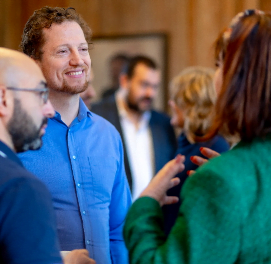
TPC Leadership develops leaders with a heart for leaders AND their organisations. They are engaged and passionate in what they do. They focus on the individual, but will always keep the vision and objectives of the organisation into account.
Janna Kramer, Learning & Talent Development Leader
EY – NETHERLANDS
Use our site switcher to easily navigate between our different offices (in your preferred language where available), or select “Global” for our head office.
Our client’s CEO was moving internally but the organisation had insufficient ‘leadership’ within the organisation to enable a successful transition and new CEO onboarding. TPC Leadership created an embedded leadership training programme to meet the outcomes of a more effective senior team to support the new CEO.
Context
The client wanted to replace a very successful CEO (and move him to the Corporate holding) but there was insufficient leadership ability in the organisation to enable the change. In addition, they aimed for creating sustainability around changes that had been made in the last 2 years and they needed a cohesive team to sustain the changes.
Objectives
A more effective senior team, supporting the new CEO
Strategic & leadership capability throughout the team
Clarity of strategic direction that the organisation wanted for the next 3 years
A method to cascade effective leadership
Interventions
An internal project team was created, and we worked with them to identify learning outcomes and organisational goals. We created an embedded leadership programme to meet the outcomes, with training of internal facilitators so that the leadership programme could be cascaded to the next level of management. TPCL had 2 management teams to bring together – Corporate and local, with approximately 15 people in the group
The programme comprised:
Assessments (using tools such as EQI and DISK) with pre-calls in which each person was given their feedback along with a discussion about the forthcoming programme
Leadership intervention (4 days, then a 3-month gap, then a further 4 days), in which the team took part in real-life scenarios and worked on team building
Strategy development for the major production facility
‘Action learning’
1-2-1 coaching between modules
Training the internal project team to enable them to cascade the programme
Outcomes
At first, they were unable to look beyond current success to see what was possible, and with our help the team is now recognised to be more resilient and much more cohesive
The team dynamics became more open and collaborative
The organisation was restructured on the back of the training and the strategic goals are now the pillar of future focus.
The new CEO feels he’s been more able to step into a leadership role, and it has been a successful transition from the old to the new CEO
As a result of this programme TPCL has been invited back to work with Corporate division
To learn more about this case or other interventions of relevance for your organisation don’t hesitate to get in touch
The Country Leadership Team, together with the CEO of a large professional services organisation and operating in a very competitive landscape, felt they needed to better equip their Directors newly promoted to Partner, with the leadership skills required in the transition to their new level of responsibility. Although they were provided with information around roles, targets, rules, regulations, etc., they were underequipped in leadership skills as there was still a dominant culture of ‘command and control’ with expertise being recognised, rewarded and promoted, not necessarily ‘leadership’.
Objectives
To foster peer solidarity & strong bonds in a cohort of Partners in order to inspire, grow and learn from each other throughout their careers
To infuse the new Partners with a mindset of being change agents, to be the ‘new blood’ in the organisation, as explicitly required by the Country CEO
To equip all Directors, newly promoted to Partner, with the required leadership toolbox
Interventions
The programme is managed by two TPC Leadership facilitators and a number of coaches. TPCL work closely with the client’s HR and partner relations teams, who supply input and the set objectives for the programme. The continuous redesign was entrusted to TPCL. Each programme is tailored to the current client needs and is key to the programme’s success.
To date, TPCL has successfully guided and coached a large number of Partners during multiple (annual) cohorts, starting in 2018. Cohorts are purposefully kept intimate to ensure a personalised journey for the entire 12-month cycle. The cycle is launched with a kick-off and encompasses three individual coaching sessions and three times two-day (off-site) training camps.
Each training camp dives deeper into key leadership development topics, namely:
Training Camp 1: Personal Leadership,
Camp 2: Team Leadership and leading change
Camp 3: System Leadership
TPCL regularly touch base with the client throughout the cycle during feedback/feedforward sessions.
The organisation saw the value in TPCL’s unique approach to facilitating, with human-to-human interaction and sharing personal experience being central. They also accepted and understood the reason for three coaches, none being facilitators, to guide the Partners in private coaching sessions, the intimacy allowing an even more open relationship in a psychologically safer space. The Partners could comfortably discuss moments they were triggered during the facilitation sessions and in day to day situations.
Working with such a dynamic, incredibly busy group of new Partners has its challenges. Managing their mental and physical presence to ensure they could all be together in the same room for more than 15 minutes, was only overcome by mutual commitment and trust in the process. Partners were eager to continue the programme remotely, following the long interruption created by Covid-19, highlighting the value the Partners had felt being together, despite the hurdles. In the session on Team Leadership, TPCL facilitators act as team coaches, observing the cohort, assessing the Partners working on a real project driven by the country leadership team. The facilitators are able to share their observations at the end of the real play session. The session on Systemic Leadership takes place directly after their annual meeting with all Partners. They had received pre-work observation questions to encourage them to observe and analyse their own system within the bigger organisation which serves as valued real-life input for their training.
Outcomes
The annual programmes, each spanning over 12 months, allows TPCL to form close relationships with the Partners. They are transformed individually, their perceptions of the new roles changed in positive ways. It became transparent to each of them in mind-shifting ‘A-ha’ moments that a Partner is not just a super director but leads teams and has to inspire and engage people. The confidence in and success of the leadership programme has allowed TPCL to return to the client year after year, offering training which is in fact an accompanied walk – the metaphor used by our client is one of mountaineering: base camp is the kick-off, training camps are the three modules – TPC Leadership were the Sherpa.
“The sessions were a great experience and have definitely delivered a lot of food for thought. I definitely think we should maintain this format for future cohorts.” feedback from a participant and Partner.
To learn more about this case or other interventions of relevance for your organisation don’t hesitate to get in touch.
Leading a business has never been easy but the events of the last few months have been more challenging than anyone could have predicted. For those sitting at board level, striving to steer their organisations through the changes that have resulted from the COVID-19 crisis, it has been a time of rapid and unprecedented learning.
As leadership coaches and consultants working with a range of organisations around the world, the team at TPC Leadership have seen first hand the impact the crisis has had. Over the last few weeks, our managing partners have been getting together virtually to discuss the key issues in a series of panel discussions.
In this week’s blog post, we join TPCL founder Charles Brook and managing partners Paula Abramovicz Erlich (Brazil), Frouke Horstmann (Netherlands), and Laurent Jacquet (Belgium) as they look at the role culture plays within a business, how it has become even more strategically significant thanks to the pandemic, and what leaders at board level can do to ensure they set and communicate an effective culture within their organisations.
Change, communication and employee retention
Most people don’t like change, especially when it might impact their security. When the pandemic hit, a lot of people were naturally very frightened. From how to adapt to home working to the worries or whether or not they’d have a job by the end of the year, employees had a lot of questions. In many cases these questions remain unanswered. And for business leaders this can have a negative impact on morale, productivity and ultimately retention.
Frouke Horstmann and Laurent Jacquet, managing partners for the Netherlands and Belgium respectively, have recently worked with a client on a culture project. Concerned about the number of people leaving the business, they asked TPCL to help them understand why people might be leaving.
The answer was simple: lack of communication. Despite having all the right intentions to communicate their plans, the leadership team had been holding back until they had all the answers. Ultimately they had decided not to let anyone go – but in the meantime, people had been scared of losing their jobs and so had decided to move on.
“The younger population – the whole world – is 24/7 these days, communication is 24/7,” says Frouke. “So even if you don’t know the answers, you have to be communicating with people, you have to let them know as far as you can what you already know, what you don’t know, what your ideas are.”
And it’s not enough to communicate practical plans either. In times of crisis the temptation is to focus on operations and ignore strategy, but setting and communicating an organisational vision is especially important when everything else is so uncertain.
“There has to be a reason for people to want to stay,” says Charles Brook. “And organisations that don’t help people connect with what they’re doing, to the reason why the organisation is there and why they as individuals are there – that meaning and purpose – are really going to struggle.”
This is particularly important in a work-from-home context, where staying connected to an organisation, its vision and its culture is that much harder. People need to know that the effort they’re making has an impact and that they have a place within a wider context.
Charles adds: “Many organisations are understandably trying to leverage performance and productivity when it comes to home working, but they sometimes don’t realise that another cost is people disconnecting. To attract and retain talent it’s important that they feel connected.”
Protecting connection and culture in a virtual world
There are benefits to remote working when it comes to talent. Without the need for people to be physically present in an office, employers can widen the net, hiring from further afield – even abroad. The accelerated new ways of working have also opened people up to different hiring approaches.
Frouke says: “The discussions CHROs are now having is, ‘Okay, maybe we don’t need to always have people on the payroll. We can think in project terms and we can take that talent for six weeks, for two days and we can bring in someone from Singapore and someone from China and someone from Amsterdam, because they have the talents that we need now.’”
But attraction and retention remain a factor. With teams not coming together physically, how can employers ensure there is a consistent and effective culture? How do we get people to buy into an organisation and gain a sense of belonging if they work every day in their own home?
“With everyone working from home we’re just having meetings, we don’t talk around the water cooler,” says Paula Abramovicz Erlich. “There’s no spontaneity. Nothing comes around of meeting in the halls and having a spontaneous idea. There’s no chit-chat in the beginning of meetings, we always go straight to the point. So what happens to culture?”
Further reading: Employees working partially from home and in the office: how do you connect your team? By Frouke Horstmann
Can culture be created – and if so, how?
For the leaders in charge of newly remote organisations, the issue of culture leads to two foundational questions – is it something that can be created and, if so, who is actually in control of that process?
Laurent Jacquet believes there are only two options – either you do nothing and a culture develops organically, or you decide on the culture you want and you communicate that down through the business.
“What are our values? How do we want to communicate? How do we want to take decisions? How do we want to work from home? Setting culture is about all of these things,” he says.
“For me, culture should be top-down – but you should of course be inclusive and listen to what everyone is saying in terms of their interpretation of the culture. My belief is that culture stems from the founder.”
In large organisations putting that into practice takes effort – especially where teams are split across different locations. If a board is setting a culture behind closed doors but failing to communicate that then it simply won’t be effective.
“It’s always down to the leadership,” says Paula. “The leadership needs to role model what the culture is, what they want everyone else in the company to do. So if the board doesn’t get the leadership on board, there is no culture change, in my view.”
Role modelling is a vital part of leading when it comes to culture. Frouke, who has written extensively on workplace culture, has worked with a number of board level clients who want to set a feedback culture, for example, but don’t include themselves within the project.
“They want to have a program starting with what I call N-1 – so starting with a level below the board,” she says.
“I find that it is fascinating. If you want to have a feedback culture, is it not the most important thing that you look into the mirror yourself? And that you role model it to the rest of the organisation?”
Communicating and developing culture
Whether a board allows a culture to emerge organically or whether they are constructionist about it and create it from the top, it is vital that it is clear what behaviours are acceptable in order to reinforce that culture.
“In some ways that’s the most important bit,” says Charles. “People need to know what is the right thing and the wrong thing to do in this culture. Otherwise, it’s very hard to get a unifying culture because people will act in different ways.
“We had a partner years ago who was probably one of the best at selling projects, so a very valuable person to have in the business. He wanted to become a senior partner but we have an annual values check where we assess whether our partners live their values and he didn’t pass that so we didn’t promote him. Eventually they had to leave.
“At one level you think, ‘We’re letting go of our best salesperson!’ but on another level if their behaviors are not going to generate the culture you want, then they have to go. And I think making some of those tough decisions is difficult for organisations but ultimately understanding what’s acceptable and not and then acting on it is really important.”
Culture has always been an important part of business success, bringing employees together, encouraging collaboration, improving morale, reducing turnover and having many other positive effects besides.
But in today’s business environment, with so much change and uncertainty, it is more important than ever. For board members and seniors leaders at the helm of their organisations, it is essential that steering the ship does not take priority over setting a course and communicating it to the crew.
Have you enjoyed this article? Be sure to catch up on the rest of the series:
How leadership is changing – and how it needs to change – in a post-pandemic world
Communication, resilience and embracing uncertainty – leadership lessons for a post-pandemic world
Boardroom evolution – what’s changing and what part has the pandemic played?
Contact us for a discussion.
@copyright TPCL (2020)
Has COVID-19 changed the make up and functioning of the boardroom? Or has it merely held up a lens and made us focus on what has been evolving gradually for some time? Perhaps the pandemic has shown us where more change is still needed if businesses are to survive and thrive in a post-pandemic world. Whatever the case, the world has changed and that means staying still isn’t an option.
With experience working across a range of organisations in numerous countries across the globe, TPCL’s partners and associates have seen up close the challenges and the opportunities facing leaders over the last few months, the things that have changed and those that still need to.
Last month we kicked off a series of articles on leadership based on panel discussions with TPCL’s managing partners from around the world. In today’s post we’re focusing on the boardroom and how it has or hasn’t changed over the last few months.
Contributing to the discussion are TPCL founder Charles Brook, and managing partners Paula Abramovicz Erlich from Brazil, Frouke Horstmann from the Netherlands, and Laurent Jacquet from Belgium.
Working together to solve problems
The role of a board of directors is, when you boil it down to a single definition, fairly straightforward – to look after the interests of the business or organisation, its shareholders and its stakeholders.
What this actually looks like in practice, however, is likely to change over time. And in the case of a global crisis like the current pandemic, it may shift more rapidly than at other times. So has that been the case this year?
Laurent Jacquet, managing partner with TPCL Belgium, believes that one way the pandemic has impacted boardrooms is by increasing the focus on leadership diversity – even if the theory has been slow to translate into practical action.
“The vast majority of people in boardrooms are there because it serves the business,” he says. “But there is an increased awareness that greater diversity in these boardrooms is required and can be overall beneficial.”
“As an example, the Belgian government’s COVID-19 working group was initially only made up of health experts and political people. Then they thought, ‘Is this sufficient? Shouldn’t we ask other people to join this expert group?’ Because it’s not only about health; they understood that it would be wise to have different perspectives.”
Resistance to change at top level?
While specific problem-solving task groups may have demonstrated an accelerated move towards diversity of expertise, in the boardroom progress hasn’t always been as fast, especially in relation to gender diversity and ethnicity.
Paula Abramovicz Erlich, TPCL’s managing partner in Brazil, says that change has been slow – and the pandemic hasn’t done much to accelerate that.
“There has been a movement to try to include more women in boards over the last few years, but it hasn’t been extremely successful yet,” she says.
“There’s resistance around getting quotas. I think quotas are a temporary mechanism that help you ‘fix’ an inequality in the short term but don’t solve the problem. There’s still a lot of prejudice around getting women on boards.”
Charles Brook, TPCL’s founder, agrees that it’s a challenge but believes that quotas can be helpful in changing cultural norms.
“It’s a hard nut to crack because people like people that are like themselves,” he says. “It’s very easy, as the CEO, to recruit in your own image. And yet we all know diversity is important.”
“I know some people will see this as controversial but in countries where they have enforced more gender equality on a board, I personally think it is a good thing. Because we have to break the norms.”
The world is demanding diversity
One important business reason for increasing diversity at board level is increased pressure from wider stakeholders.
Charles says: “For some of my clients in the consulting world there’s been a very strong push from their clients to have wider, more diverse representation. So it’s becoming more client led, where clients are really having to be heard.”
Frouke Horstmann, TPCL’s managing partner for the Netherlands, agrees – but acknowledges that balancing stakeholder interests is a real challenge for board members.
“There’s a lot of pressure from society for boards to be more focused on not only profit creation but real value creation. The pool of stakeholders has broadened so it’s not only about focusing on the shareholders who put in money in your company, but all people.”
“There’s more focus on purpose and planet, more B Corp organisations – not just the smaller businesses but bigger ones like Danone in the US. The problem is that some boards really get on board with this but then the more old-fashioned shareholders do not always buy into that. So there’s this real tension for them.”
Of course, representation – having the ‘correct’ number of women, ethnic minorities and so on at board level – is just a first step towards true diversity.
“It’s one thing having a diverse group of people in a boardroom and then there’s how much space they get to share their views and how much their views are valued and acted on,” says Charles.
“One way I believe COVID has positively impacted on diversity is that many board meetings, if not all, are happening virtually now and I’ve noticed that people are having more of a say because of that. Technology is more or less forcing more people to have a voice. It’s harder to sit in a room and just talk over other people.”
In fact, restrictions on travel and the resultant increase in remote meetings thanks to the pandemic may well mark a long term step change that allows a wider pool of people to input into what might once have been more local conversations.
“People are starting to say, ‘I’m not traveling for a four-hour meeting. This is working fine over Zoom.’” says Paula. “Board members don’t all necessarily live in the same city, so we may see more representation of different countries or cities coming together more easily.”
Operations vs strategic focus
Another change that TPCL’s leaders have noticed since the pandemic started is the shift from strategic discussion to more operational conversations. This, our experts warn, is natural but could be dangerous in the long term.
“The current situation is forcing more tactical conversations to be happening in the boardroom, because things are changing on a day-to-day basis,” says Charles.
“There’s less and less time spent stepping back and looking at the big picture and wider system. Less and less time spent on the why. Why are we here? How can we engage with the ‘why’? I think that’s an issue, albeit a downstream issue.”
The problem with prioritising operations over strategy is that it can be all too easy to lose sight of the organisation’s vision. This can filter down into every level of the business, ultimately resulting in a disconnect for the very people who keep the business operating on a day to day basis.
“Due to the crisis a lot of boards are in survival mode, either just holding on in there, trying to survive or at best trying to see how to create opportunities,” says Laurent. “That means that wider systems and purpose have been put a little bit on the side. But people need to put that back on the table.”
“I’m talking to a lot of people who are saying, ‘I’m actually starting to disconnect from my organisation, because if I work for A or for B, there’s no difference. I’m working from home in front of my computer and that sense of belonging is starting to fade away.’”
“It is that risk of lower engagement and difficulty in holding onto their people that puts the purpose and the why back in front of the boardroom table. They may be in survival mode but they still need to keep that in mind.”
In part two of this discussion featuring Charles, Frouke, Laurent and Paula, we’ll pick up on the theme of employee engagement and explore the important subject of culture. Keep an eye out on our social channels or sign up for our newsletter to stay up to date with the latest insights from TPCL’s Leadership experts.
Contact us to learn more about how we can help or check our leadership consultancy services.
@copyright TPCL (2020)
No project within an organisation can be deemed a success unless its results can be measured. Equally no leader can lead without some idea of destination.
As leadership consultants we sometimes feel like detectives, asking questions of everybody who might be invested in the project. Just as a detective is trying to get to the bottom of their suspect’s story, we too just want to understand the whole picture. We’re trying to uncover all there is to know about the current situation and establish the end point we want to reach.
And then we’ll put in place measures to ensure we will know when we’ve successfully achieved those ambitions.
Asking the right questions
All of this is necessarily a series of questions in one form or another.
Andrea Cardillo, TPCL Managing Partner in Milan, starts from the endpoint. The fundamental question: What are the business goals the organisation is trying to achieve? And what challenges is the organisation facing that might prevent it being able to meet these? Think internally and externally.
Next he looks at the behaviours that would best support the organisation to achieve those goals and the culture and structure required to support those behaviours. Finally, the style of leadership that will create that culture.
It’s a systemic approach that can be summarised in four steps. Each of which, he suggests, can be defined by different KPIs and goals:
The overall goals and the challenges to bring the vision up to date
The behaviours supporting these goals
The culture fostering these behaviours
The leadership style promoting that culture
Choosing the right tools
As management consultants we have numerous tools in our arsenal; it’s just a matter of choosing the right ones. But in order to do that we must understand implicitly what we’re trying to find out. What are we trying to assess? Is it employee satisfaction? Happiness of customers? Business results? Behavioural habits?
This underlines the importance of being able to figure out precisely what the problem is or what we’re trying to do because without knowing that we can’t hope to measure our success.*
We might use specific KPIs to assess productivity, surveys to assess engagement or psychometrics to access potential. But the tool has to fit the job for its result to offer any certainty.
If the goal is a reduction in staff turnover for example, we could measure engagement through employee surveys. We may see a high level of engagement translate to a reduction in turnover or absenteeism. But to create the right tools we must understand what we’re looking to discover from the answers.
Remember it’s a marathon not a sprint
Success in a leadership consultancy project isn’t always seen in the immediate term. Changes take time to bed in, time to enter the organisation’s consciousness. Creating a leadership model is easy and can be relatively quick, but translating that into HR structures or strategies in a way that creates a lasting, discernible change in culture can take years.
It’s only then, by tracking results over time and looking for consistent positive change that we are able to say whether the steps that were taken were the right ones and whether our goals have been met.
It can be difficult to correlate HR led culture change to a direct impact on productivity. But that doesn’t mean you shouldn’t try.
If you’d like to learn more about our proven track record of results, contact the authors or your local TPCL team for a conversation about your organisational objectives and challenges.
Co-written by Andrea Cardillo, Managing Partner TPCL Italy and Christian Scholtes, Managing Partner TPCL Romania @Copyright TPCL (2020)
Navigating change is now more important than ever. This article is part of a six-part TPC Leadership original series on leadership consultancy – and its role in helping organisations engage with the bigger picture while staying adaptable to the present moment. Check out the next article in this series: ‘When might you need leadership consultancy and who should be involved’.
The issue of leadership is often only narrowly understood. Many see leadership as a position, others as a set of skills, a capacity to influence, but all of these perceptions miss the nuances of being a leader. And the complications.
Leadership is a dynamic relationship. It is fluid, impacted by organisational culture (see more in our previous blog post ), by the needs of others and by world events. So much affects the leadership in our organisation that it can feel impossible to untangle. But we need to untangle it. And when we do, we are able to deeply connect individual talents and values with organisational purpose and strategy, developing a system that enables all leaders to thrive, while adding real value to clients and key stakeholders.
Adapting to world events
The impact of the financial crisis of 2008/2009 can still be felt today. Many organisations we work with say the issues never ended. They’re still driven to double and triple check everything they do. To proceed with caution in all things so that from the top down, the organisation can feel assured about the success of every endeavour, no matter how small or large.
Financial pressure created a preference for safety over innovation. Our organisational structures shifted towards survival. And quite apart from the skills leaders may or may not have been taught, their capacity to lead became constrained.
If the tolerance and celebration of risk-taking took a hit from the financial crisis, it will be important to evaluate what impact that the coronavirus has both now and in the future. Whether we are affected by decreased demand, quarantine or halted production, we will unconsciously adapt to the new rules of play. It will be essential for us to keep asking questions, to consider the impact of the changes we make and to hold onto the core values and purpose that makes our organisations what they are.
Considering every need and impact
Traditional leadership focused on the need to increase sales and efficiency. But this focus is too narrow for our changing world. Now the wider world affects leadership and leadership affects the wider world.
Too often we have focused on the means of creating profit, without considering its impact. Leaders have been driven by shareholders’ ends, without questioning those ends. And this has left its mark on the environment, the market and society.
If leadership is a dynamic system, it is more than a function. It is not about making things happen but asking what should happen in the first place – and why. We cannot consider ethics as an afterthought. Ethics aren’t something to temper the impact of profit-making. They can be the entire reason we are doing business in the first place.
We need to take our values and purpose seriously, to focus on what matters most. There are environmental and social ends we care about that we have compromised – consciously or unconsciously – because we have perceived leadership too narrowly. We have focused on the immediate and missed out on our reason for being.
This is where leadership consultancy is essential. It connects us back to the people we are serving, to the values that define our personal and organisational vision. No organisation aspires only to meet the bottom line. We know that we have a more important part to play. Leadership consultancy realigns us with the purpose we may have forgotten.
Crossing the unknown
The etymology of the word leader is rooted in the role of a guide. The kind of person who would help you cross an unknown land – perhaps a forest or mountain range – from one point to another. What kind of person would you want for a guide?
Today we are still crossing the unknown. There are world events and changes that threaten to be unnavigable. There are systems and cultures we work in that permeate our thinking so that it’s hard to separate our own priorities from the demands of the day. It can be hard to remember why we’re even travelling at all. On an organisational level, leaders can stay lost in the woods, perhaps forgetting that they ever meant to journey to another destination. It’s easily done. After all, this isn’t a reflection on our ability, but a reflection of the dynamic and ever-shifting system of leadership.
That’s why we do leadership consultancy. It’s about helping entire organisations to cross the desert safely. To remember what’s important. To hold fast to their vision despite the manys obstacles and get to their destination: a place that has a real and good impact on the world they are a part of. They’ll end up making a profit as well. But they do it without compromising.
We want to ask you the hard questions, to help you understand the importance of reflection. We won’t forget the needs of day-to-day business, but we’ll integrate them with an understanding of human behaviour and mindsets – connecting the day-to-day to the bigger picture, to your reason being, to the people you serve. We won’t just stop at self-discovery, or structures and process, we’ll help you follow through to support behavioural changes in your people.
Let’s walk together on this journey through the unknown. Check out our leadership consultancy services or contact your local TPC Leadership team to begin the conversation.
Navigating change is now more important than ever. This article is part of a six-part TPC Leadership original series on leadership consultancy – and its role in helping organisations engage with the bigger picture while staying adaptable to the present moment. Next in the series: The importance of setting the right goals and measuring the right results.
Co-written by Andrea Cardillo, Managing Partner TPCL Italy and Christian Scholtes, Managing Partner TPCL Romania.
Copyright@ TPC Leadership (2020)
Start thinking about leadership structures
It’s an oft-repeated maxim that leaders create other leaders. But without the right structure in place, you might wonder why it doesn’t seem to work.
Structure drives behaviour. If you are not intentional about the former, you will not be able to shape the latter. Too often, in a rush to create results, we focus on symptoms rather than the underlying causes. Next to organisational culture, organisational structure is one of the most significant influencers of them all.
The pathway defines the traveller
On what basis are people promoted in your organisation? Is it because they have displayed initiative or because they have been loyal? Because they have been innovative or because they have mastered the status quo? The way we review people will determine who they want to become.
It is not the fault of the builder if the architect has supplied flawed blueprints. Our promotion and reward system maps out a route for those in our organisation to follow. If the route to the top is fraught with caution and loyalty, we can hardly expect them to suddenly develop a taste for risk-taking and originality once they get there. The pathway to responsibility determines the quality of the people who will eventually take hold of it.
The entrypoint affects the endpoint
It is common to recruit people based upon their technical skills and expertise, but at the hiring stage we often undervalue emotional intelligence. And this has more impact than we realise. Later, when we want to develop these individuals into leaders, they won’t suddenly develop social skills or the ability to inspire others. We end up with many specialists but few leaders.
Our preoccupation with hard skills and hard data means that we can become deficient in the soft skills that are so integral to great leadership. It doesn’t matter what style of leadership is modelled on an executive level, if to get there you first have to suppress those same qualities.
In an attempt to temper these trends, organisations often turn to leadership training. The hope is that a three-day course or weekly meeting about the merits of innovation or endurance will be enough. But you cannot change the course of a river by persuading it to go uphill. If you want real results, you need to dig out a new channel.
The smallest thing affects everything
Structure is everywhere in organisations. While there are large overarching structures that affect everything, micro-structures also reveal important trends.
How is a typical meeting structured? Is it a dialogue or a series of monologues and presentations? What space is dedicated to challenging leaders or ideas? To learning? To feedback? The smallest social interaction can reveal whether we are encouraging people to compete or share, to protect their interests or grow together.
It’s about what’s beneath the soil
So how do we begin to change our leadership structures? How do we construct something new without succumbing to the same traps? In the pressures of the coronavirus pandemic, our attention can be focused on ensuring weeds stay beneath the soil. But if our organisations are to be robust, we have to confront what is unspoken, uncomfortable and underneath the surface.
Is there an emotion that is not okay to feel if I don’t want to be put aside? Our structures and microstructures both reveal and determine how individuals and teams interact, whether or not anyone ever asks for help, and how we respond to failure. If everyone is preoccupied with appearing to be in control, you can bet that no-one is growing into a good leader. But if we confront the problematic aspects of our structures, if we question our underlying assumptions, it might get uncomfortable, but we’ll end up with a distributed leadership culture that enhances our focus, promotes good relationships and fosters good leaders. Maybe even great ones.
Ready to evaluate the leadership structures in your organisation? To create an opportunity for great leaders to emerge? Check out our leadership consultancy services or contact your local TPC Leadership team to begin the conversation.
Navigating change is now more important than ever. This article is part of six TPCL’s articles on leadership consultancy – and its role in helping organisations engage with the bigger picture while staying adaptable to the present moment. Next in the series: ‘Leadership is part of a much wider picture’.
Co-written by Andrea Cardillo, Managing Partner TPCL Italy, and Christian Scholtes, Managing Partner TPCL Romania, 2020
What is leadership consultancy? Let’s ask another question: Does leadership matter? For every instance where leadership plays a part, leadership consultancy has a place and potential for impact.
Organisations are shaped by leaders who in turn are shaped by the structures and culture of the organisation they are part of. It’s a circular system of influence. One that is difficult to accurately assess when you’re caught up in it. That’s where leadership consultancy comes in.
Leadership consultancy leverages your unique strengths
Andrea Cardillo, a TPC Managing Partner in Italy, defines leadership consultancy as ‘a consultative and facilitative process to support organisations to understand what leadership models and structures would best serve the business strategy, leveraging on the unique traits and strengths of a particular culture.’
Leadership consultancy is a holistic way of looking at your leadership capacity and turning it to your ultimate advantage. It is not a training program, nor is it executive coaching, It is a way of tackling the entire system of leadership and aligning it with what the organisation is and aspires to be.
You can’t transfer or replicate solutions from one organisation to another. For this reason, consulting is about having good conversations – an in-depth dialogue between the external consultant and internal leaders. We always need to find a uniquely nuanced strategy that is optimised for the situation. And this comes from digging deep into the organisation’s own leadership solutions, history and potential.
Leadership consultancy discovers potential
Often organisations harbour a huge capacity for leadership, but only a fraction of it ever sets sail. It’s only through asking difficult questions that we can understand this untapped potential.
The right questions reveal where assumptions are holding an organisation back. For instance, people may assume that leadership is centralised. That leadership is only for senior managers, while the role of everyone else is compliance.
We have found that many managers assume leadership is not a primary part of their role. When we asked managers in one organisation to rank the priorities of their role, most listed managing and the completion of tasks in their top two. Very few managers ranked leadership high. Because they didn’t prioritise it, they did not invest in it, and they were less likely to display initiative or make courageous decisions.
Often people associate leadership with a set of skills they may or may not be developing. But they don’t realise the importance of taking ownership of their role as a leader. If you don’t perceive yourself as a leader, you inevitably will not act like one. And if an organisation is largely made up of people who do not act like leaders, their leadership capacity is stunted.
If we’re going to find, harness and maximise the leadership capacity already in our businesses, we need leadership consultancy to bring our potential to light.
Leadership consultancy brings awareness
Leadership consultancy helps you intentionally realign your leadership model with your aspirations, so that your structure doesn’t unconsciously distort your vision.
Even if you don’t believe you have a leadership model, you do. Even if you don’t intentionally think about it, its impact will unintentionally affect everything in your business, particularly in HR.
Everything from your talent management strategies to compensation and benefit streams can be linked back to your leadership model. Any recruitment strategy you create will also be inescapably influenced by it. Engagement, operations, financial performance – everything is affected. Leadership consultancy helps to uncover this correlation
Leadership consultancy makes organisations robust
No single human can navigate through life while remaining unchanged. How much more the case for organisations, which are formed hundreds or thousands of people, all experiencing different personal changes. Once you factor in the effects of internal growth, departures and shifts in the market, it is clear that no organisation is ever in stasis.
Leadership consultancy helps guide businesses through change, preserving their best qualities while enabling them to stay effective. Businesses cannot just do as they always did because a strategy formed two years ago is unlikely to have the exact same effect this year. This would have been relevant for any organisation that experienced a significant shift, such as a small business doubling in size. But given the current pandemic, every business faces huge change. Our strategies and leadership models must be adapted, so we can navigate through this difficult time.
The irony is that by refusing to adapt, you can actually lose the unique qualities that make your organisation special. But at the same time, you cannot move forward authentically without reference to the past. This is why leadership consultancy is essential. It helps untangle what is important to an organisation’s identity from attitudes that prevent the organisation thriving through change. It keeps the core of the organisation robust.
If you want to unlock leadership potential in your organisation, or keep the core of your organisation robust through change, contact us to begin the conversation.
In this blog, TPC Leadership’s Founder Charles Brook explores the differences between leadership coaching and leadership consultancy and when you might need each or indeed both.
What kind of change do you need?
Sometimes coaching isn’t as fast and far-reaching enough to bring the shift you need in your organisation. And sometimes consultancy can miss the underlying mindsets that might be the real obstacle to progress.
Broadly speaking, leadership consultancy steps back to see the big picture, while leadership coaching steps closer to address the personal. But there’s more to it than that. The individual breakthrough that coaching brings inevitably creates waves that break upon the wider picture. Consultancy might result in an organisational shift that gives individuals the space they need to thrive. And then there’s ‘team coaching’ which can also lead to lasting culture change. So which is right to invest in and when?
The power of consultancy
“My greatest strength as a consultant is to be ignorant and ask a few questions.” Peter Drucker
Investing in leadership consultancy invites experts to analyse your organisation. The focus is on transforming structures and processes to align with your organisation’s objectives. It’s a chance to look under the bonnet of the system, to check that this vehicle is hitting the track on all cylinders.
Periods of significant change call for consultants. If you’re going through a merger, have a new CEO or strategy, or are experiencing rapid growth, then you want to look at the wider picture. Consultancy will help the organisation as a whole to adapt to new waters, to evolve and stay effective.
While coaching can assist key individuals with transition, consultancy connects the dots and makes everything work. If there is something amiss on a systems level, consultancy will bring it out of the shadows and light it up. Solutions for how to move forward can then be developed and the organisation can achieve their objectives for the short, middle and long-term.
In essence, consultancy provides leaders with the tools to optimise their organisation. Whereas coaching looks closer at the tool-wielders themselves…
The significance of coaching
“I absolutely believe that people, unless coached, never reach their maximum potential” – Bob Nardelli, CEO of Chrysler
A perfect system is still a broken one if leaders don’t have the mindsets to match it. Your intentions may be noble, but if you don’t know how to navigate your learned instincts, your actions will not follow suit.
Coaching drills into the bedrock of leaders. It brings their best qualities to the surface and addresses damaging mindsets hidden in the foundations. If you want to build a legacy that lasts, you cannot skip this part of development. The danger with relying on consultancy at the expense of coaching is that your organisation can learn to bail water in expert fashion, without ever addressing the holes in the bottom of the boat.
What about both?
“If you give a good idea to a mediocre team, they will screw it up. If you give a mediocre idea to a brilliant team, they will either fix it or throw it away and come up with something better.” – Ed Catmull, Creativity inc
There are benefits to investing in consultants that are also experienced coaches. They’re also more likely to ask better questions and listen, instead of jumping in with a stock solution. They can also identify where consultancy has its limits and how coaching could aid the consultancy process.
Ultimately, both leadership consultancy and coaching exist to tap into human potential. Systems affect people and people affect systems. If one is askew, the other cannot find balance. Probably the best question to ask is, which do I need first?