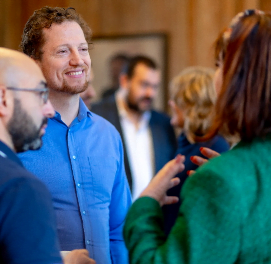
TPC Leadership develops leaders with a heart for leaders AND their organisations. They are engaged and passionate in what they do. They focus on the individual, but will always keep the vision and objectives of the organisation into account.
Janna Kramer, Learning & Talent Development Leader
EY – NETHERLANDS
Use our site switcher to easily navigate between our different offices (in your preferred language where available), or select “Global” for our head office.
At TPC Leadership we work extensively with Professional Services companies, supporting them to develop talent. In this second blog of the series TPC Leadership UK’s Associate Partner Catherine Bardwelland AssociatePeter Walldiscuss how to define and measure high potential amongst your teams.
How do you define and measure high potential (and avoid elitism)
It is difficult to predict how people will develop as their careers unfold. Some high potential employees are obvious, others are harder to draw out. While there are tools to help managers identify and measure high potential, the process will always rely partly on human judgement.
Catherine Bardwell, TPC Leadership Associate Partner, and Peter Wall, TPC Leadership Associate, explore how clear roles, shared responsibility and an inclusive approach are key to successfully identifying and nurturing all high potential employees.
What are the key success criteria that define high potential?
High potential is usually defined by an employee’s ability, drive and social skills. Catherine stresses, “It’s a balance. You can’t just measure the results leaders deliver or their IQ. How they develop trust and motivate others is an important indicator of their emotional intelligence too.”
When C-suite members are looking to define high potential, they should take a holistic approach – consider a candidate’s emotional intelligence, their ability to work collaboratively across boundaries and how they influence teams. They will need to draw on all of these elements to achieve sustained high performance in today’s increasingly complex and diverse organisations.
Developing emotional intelligence starts with increasing self-awareness. This shouldn’t be underestimated. The more a leader understands how their personal feelings may impact reactions and decisions, the less likely they are to demonstrate subconscious bias or promote elitism.
Make developing people a performance objective
If leaders are to truly embrace and value the process of identifying and developing high potential, they must be measured on it.
Peter explains that best practice is for leaders to have “developing, identifying and nurturing people” as part of their performance review. “If you’re measured on it as part of your job, you’ll do it and you’ll take it seriously” he says.
The difference between good leaders and outstanding leaders, Peter explains, is that good leaders ask, “how do I get this done?” while outstanding leaders ask, “how can I use this to give someone an opportunity to stretch and grow?” They focus on the inputs at least as much as they do the outputs.
Some businesses choose to appoint an employee in HR to manage talent identification and development. The danger of this is that line managers may then abdicate responsibility for developing their people. The focus must be on shared responsibility – an HR professional may oversee development, ask challenging questions and act as a conscience, but managers are best positioned to spot, measure and nurture talent in their teams.
Share responsibility and adopt a coaching culture
The idea of shared responsibility in measuring high potential can be encouraged through creating a coaching culture. Catherine explains that a successful coach will provide three key building blocks:
Create awareness within the coachee by asking probing questions that help guide them through a process.
Offer choices – it’s not about one career path, but about exploring what’s important for them.
Make the coachee responsible for their journey so they feel empowered to drive forward.
Peter explains that traditionally, when senior leaders try to manage and measure someone else’s career, they take a problem-solving approach. “They’ve learned to help people by offering advice telling them what they should do to fulfill their career aspirations – after all, that’s how they’ve got to where they are.”
“They’re trying to be helpful,” says Peter, ‘but a shift in mindset is needed. Now the best leaders are realising that they can help people make progress by supporting them, stimulating them, asking questions and challenging assumptions.” Their responsibility is to guide and oversee – it is the individual who takes responsibility for their own career journey.
Avoiding elitism
There is a danger that measuring high potential can lead to bias, elitism and ‘cloning’ – where leaders subconsciously choose to develop people who are like them.
We have a human tendency to gravitate, particularly when under pressure, towards people whose personality fits with our own. Peter refers to when he worked as a coach with a team on an engineering project. The project was struggling, and the pressure was on.
Peter recalls the manager saying, “if everyone was just like me this would be so much easier” and immediately laughing in disbelief that he’d said it. Regardless of our values and best intentions, we can still revert back to a self-preserving mindset when the pressure’s on.
The best leaders then, will meet the needs of the business rather than their personal need for security or superiority. They will practice continual self-awareness and development and strive to make conscious, objective, fair decisions when defining and measuring high potential.
Looking for insight on how to develop high potential in your organisation? TPC Leadership ‘s tailor made approach works specifically with Professional Services to reveal and develop high potential talent. Contact us for more information about our leadership solutions.
In this blog TPC Leadership UK’s Associate Partner Catherine Bardwell and Associate Peter Wall discuss how to define and measure high potential amongst your teams.
How do you define and measure high potential (and avoid elitism)
It is difficult to predict how people will develop as their careers unfold. Some high potential employees are obvious, others are harder to draw out. While there are tools to help managers identify and measure high potential, the process will always rely partly on human judgement.
Catherine Bardwell, TPC Leadership Associate Partner, and Peter Wall, TPC Leadership Associate, explore how clear roles, shared responsibility and an inclusive approach are key to successfully identifying and nurturing all high potential employees.
What are the key success criteria that define high potential?
High potential is usually defined by an employee’s ability, drive and social skills. Catherine stresses, “It’s a balance. You can’t just measure the results leaders deliver or their IQ. How they develop trust and motivate others is an important indicator of their emotional intelligence too.”
When C-suite members are looking to define high potential, they should take a holistic approach – consider a candidate’s emotional intelligence, their ability to work collaboratively across boundaries and how they influence teams. They will need to draw on all of these elements to achieve sustained high performance in today’s increasingly complex and diverse organisations.
Developing emotional intelligence starts with increasing self-awareness. This shouldn’t be underestimated. The more a leader understands how their personal feelings may impact reactions and decisions, the less likely they are to demonstrate subconscious bias or promote elitism.
Make developing people a performance objective
If leaders are to truly embrace and value the process of identifying and developing high potential, they must be measured on it.
Peter explains that best practice is for leaders to have “developing, identifying and nurturing people” as part of their performance review. “If you’re measured on it as part of your job, you’ll do it and you’ll take it seriously” he says.
The difference between good leaders and outstanding leaders, Peter explains, is that good leaders ask, “how do I get this done?” while outstanding leaders ask, “how can I use this to give someone an opportunity to stretch and grow?” They focus on the inputs at least as much as they do the outputs.
Some businesses choose to appoint an employee in HR to manage talent identification and development. The danger of this is that line managers may then abdicate responsibility for developing their people. The focus must be on shared responsibility – an HR professional may oversee development, ask challenging questions and act as a conscience, but managers are best positioned to spot, measure and nurture talent in their teams.
Share responsibility and adopt a coaching culture
The idea of shared responsibility in measuring high potential can be encouraged through creating a coaching culture. Catherine explains that a successful coach will provide three key building blocks:
Create awareness within the coachee by asking probing questions that help guide them through a process.
Offer choices – it’s not about one career path, but about exploring what’s important for them.
Make the coachee responsible for their journey so they feel empowered to drive forward.
Peter explains that traditionally, when senior leaders try to manage and measure someone else’s career, they take a problem-solving approach. “They’ve learned to help people by offering advice telling them what they should do to fulfill their career aspirations – after all, that’s how they’ve got to where they are.”
“They’re trying to be helpful,” says Peter, ‘but a shift in mindset is needed. Now the best leaders are realising that they can help people make progress by supporting them, stimulating them, asking questions and challenging assumptions.” Their responsibility is to guide and oversee – it is the individual who takes responsibility for their own career journey.
Avoiding elitism
There is a danger that measuring high potential can lead to bias, elitism and ‘cloning’ – where leaders subconsciously choose to develop people who are like them.
We have a human tendency to gravitate, particularly when under pressure, towards people whose personality fits with our own. Peter refers to when he worked as a coach with a team on an engineering project. The project was struggling, and the pressure was on.
Peter recalls the manager saying, “if everyone was just like me this would be so much easier” and immediately laughing in disbelief that he’d said it. Regardless of our values and best intentions, we can still revert back to a self-preserving mindset when the pressure’s on.
The best leaders then, will meet the needs of the business rather than their personal need for security or superiority. They will practice continual self-awareness and development and strive to make conscious, objective, fair decisions when defining and measuring high potential.
Looking for insight on how to develop high potential in your organisation?Get in touch with us to find out how we can help.
In the third blog of our series exploring developing high potential talent, TPC Leadership UK’s Associate Partner Catherine Bardwell and Associate Peter Wall focus on uncovering talent throughout an organisation, not just those that sit inside the 9-box grid.
How do we uncover talent throughout the organisation and not just people in the 9-box grid?
Successful leaders value, inspire and develop all their people. When we allow a proportion of the workforce to be sidelined, we risk demotivating those people and missing the opportunity to develop hidden talent that could enhance our business.
So how do we nurture and release the talent of everyone in an organisation, instead of only the so-called high potential leaders who stand out and obviously tick all the boxes?
TPC Leadership Associate, Peter Wall says a more collaborative, flexible approach is needed and that investment in talent should encompass all employees, regardless of whether they have high potential – it is the job of the leadership to spot and nurture talent in all their people. Peter asks, “Might it be better to focus on marginal gains and get everyone to be 3% better, than to get a select few to be 10% better?”
Think outside the 9-box grid
The 9-box grid is a commonly used talent management tool that helps leaders manage employees in an organisation. The framework allows leaders to map people across nine groups based on their performance and potential. It focuses on two trajectories: how well employees are performing now and how they might perform in the future.
But what about those people who don’t conform to the models of the 9-box grid or who slip through the gaps in the net? While the 9-box grid has its place, Peter and TPC Leadership Associate Partner Catherine Bardwell are in favour of a more collective approach, where leaders act as coaches and mentors who challenge and support high potentials, while allowing them to take responsibility for their own journey.
The 9-box grid relies on the personal judgement of managers who decide which box an employee should be placed within. It’s human nature, especially when under pressure, to gravitate towards the familiar – to seek out and favour personalities who mirror our own. With such reliance on opinion there is a risk that decision makers simply produce clones of themselves.
But leaders must put the needs of the business first and think beyond the 9-box grid recipe for developing high potential leaders: everyone has talent and allowing it to shine builds a diverse workforce who provide multiple gains across a business.
Promote sideways as well as upwards growth
Catherine and Peter challenge the idea that growth potential should be restricted to climbing a hierarchy. Some talent, as well as some high potential leaders, will enrich gaps in a business by growing sideways rather than upwards.
Sideways growth presents employees with opportunities to gain different experiences, embrace new challenges and add depth and breadth to their knowledge. Being open to developing people sideways helps to create a culture of growth and empowerment and allows a business to uncover, nurture and make gains from all talent, not just those in the 9-box grid.
Talent is only ever on loan
If you are to cultivate genuine talent and inspire meaningful growth in all employees, people must be given the space to direct their own path. “It’s about giving people room to breathe.” says Peter.
He takes a close relative’s career journey as an example. Appointed by a large, public sector organisation through their Finance Graduate Scheme, she was talent spotted early on and experienced several rapid promotions. But after a while, she decided she wanted to gain broader experience in a different sector and left the organisation. Her mentor, instead of coaxing her to stay, supported her decision to explore a different path and they kept in touch.
Years later, she was enticed back to another more senior role at that same public sector organisation. Having gone with her mentor’s blessing, she returned better equipped, with new experiences, broader skills and different insights.
“Her mentor embodies the idea that we’ve got our best people on loan” says Peter. “If talented people want to go, let them, but give them your blessing and embrace them in your network. They may well come back.
“But even if they don’t, they will speak well of your organisation to others and you’ll get a reputation for nurturing and allowing people to grow, which can make a big difference in a competitive employment market.”
Encourage personal responsibility
Talent can be uncovered in one organisation but allowed to grow in another. Catherine relates this to the 70-20-10 rule, which determines that people tend to learn 70% of their skills from challenging experiences, 20% from developmental relationships, and 10% from training. Peter’s relative’s mentor saw the value in expanded experience and valued her as part of his network — and it paid off for both in the longer term.
The best mentors encourage people to take responsibility for themselves but they also support and empower them on that journey. The talent identification and development process must move away from the directive approach where leaders and mentors manage people’s careers, towards self-led, experience-based learning and development. “It’s about asking them the right questions, not giving them what we think are the right answers” says Peter.
Want to uncover talent in your organisation?Get in touch with us to find out how we can help.
In the fourth blog of our series exploring developing high potential talent, TPC Leadership UK’s Associate PartnerCatherine Bardwelland Associate Peter Wall focus on how giving potential leaders the space to grow and display their potential is an essential part of their development.
Focus on inputs rather than outputs
TPC Associate, Peter Wall believes part of creating space for potential leaders to excel comes down to what their leaders perceive their role to be. If a manager sees their job as getting results with minimum risk, they’ll take the most direct path – often a short-term approach that overlooks investing in talent for the future.
But other leaders see it as their job to harness and nurture all those who are creating the results. In doing so, they enable potential leaders to shine, and the results look after themselves. “You have to be a bold person to focus on the inputs rather than the outputs,” says Peter, “but that’s what the best leaders do”
Allow people to make mistakes
Allowing people to make mistakes is a way of giving them space. Peter recalls a leader once saying to him: “Peter, I want you to make mistakes. Just not too many and never the same one twice. Because if you’re not making mistakes, you’re not taking risks, innovating and learning.”
Being given permission to try things and get things wrong is liberating and gives people the opportunity to learn. It’s inevitable that even the very best people will make occasional mistakes, but “it’s about catching them when they happen, even when the pressure’s on” says Peter. That way you can create an environment where the emphasis is still nurturing and developing the inputs rather than just obsessing about the outputs.
Create opportunities for exposure
So how do you give leaders exposure to those at the top of the organisation? Even in organisations with a flattened hierarchy, there may still be an ‘invisible hierarchy’ within the company and its culture.
“Senior leaders need to have humility,” explains Peter. They need to possess the modesty to stand back at the right time and give high potential leaders the chance to shine. To create opportunities for them to take on high profile challenges but be there to support them (catch and help them recover from any missteps) and then publicise and celebrate their successes.
Gaining experience working directly with senior leaders will help potential leaders understand how their managers work and what is important to them. And having insight into those values at the top is key to being able to influence upwards.
“We have to do politics in companies, because it’s there”
Employees can often try to “not play the game” when it comes to office and company politics. But Peter suggests that this approach can work against potential leaders – “it’s better to recognise the politics and engage with it with integrity. There is a political game in play, so you can’t turn away from it.”
Catherine Bardwell, TPC Associate Partner, refers to the “4 different types of political animals”, a model developed in the 1980s by Simon Baddeley and Kim James, to identify the political style and motivations of people in the workplace.
The framework categorises people as one of four ‘political animals’: sheep, donkeys, owls and foxes. Understanding the categories can help leaders with their own self-awareness as well as give insights into how to lead others correctly and fairly, in what is inevitably a political environment.
Company structures, politics and cultures vary across the globe. Alongside internal politics, the better equipped high potential leaders will have an awareness of how different societies function and the influence that has on organisations. Geert Hofstede’s Six Cultural Dimensionsmodel is a good starting point to gaining greater understanding of how different cultures could be influenced by a different mix of factors such as power-distance norms.
Collaboration is key
An environment where collaboration and humility are prevalent will be one where potential leaders can excel and influence upwards. Leaders who choose to surround themselves with people who are more talented, or have different talents to themselves, will enable potential leaders to shine and impact change.
Working collaboratively while allowing high potential leaders to have autonomy creates the space they need to grow and realise potential. As Catherine says, “the best leaders are those with the best support network.”
Want more insight on how to move forward?Get in touch with us to find out how we can help.
What is leadership consultancy? Let’s ask another question: Does leadership matter? For every instance where leadership plays a part, leadership consultancy has a place and potential for impact.
Organisations are shaped by leaders who in turn are shaped by the structures and culture of the organisation they are part of. It’s a circular system of influence. One that is difficult to accurately assess when you’re caught up in it. That’s where leadership consultancy comes in.
Leadership consultancy leverages your unique strengths
Andrea Cardillo, a TPC Managing Partner in Italy, defines leadership consultancy as ‘a consultative and facilitative process to support organisations to understand what leadership models and structures would best serve the business strategy, leveraging on the unique traits and strengths of a particular culture.’
Leadership consultancy is a holistic way of looking at your leadership capacity and turning it to your ultimate advantage. It is not a training program, nor is it executive coaching, It is a way of tackling the entire system of leadership and aligning it with what the organisation is and aspires to be.
You can’t transfer or replicate solutions from one organisation to another. For this reason, consulting is about having good conversations – an in-depth dialogue between the external consultant and internal leaders. We always need to find a uniquely nuanced strategy that is optimised for the situation. And this comes from digging deep into the organisation’s own leadership solutions, history and potential.
Leadership consultancy discovers potential
Often organisations harbour a huge capacity for leadership, but only a fraction of it ever sets sail. It’s only through asking difficult questions that we can understand this untapped potential.
The right questions reveal where assumptions are holding an organisation back. For instance, people may assume that leadership is centralised. That leadership is only for senior managers, while the role of everyone else is compliance.
We have found that many managers assume leadership is not a primary part of their role. When we asked managers in one organisation to rank the priorities of their role, most listed managing and the completion of tasks in their top two. Very few managers ranked leadership high. Because they didn’t prioritise it, they did not invest in it, and they were less likely to display initiative or make courageous decisions.
Often people associate leadership with a set of skills they may or may not be developing. But they don’t realise the importance of taking ownership of their role as a leader. If you don’t perceive yourself as a leader, you inevitably will not act like one. And if an organisation is largely made up of people who do not act like leaders, their leadership capacity is stunted.
If we’re going to find, harness and maximise the leadership capacity already in our businesses, we need leadership consultancy to bring our potential to light.
Leadership consultancy brings awareness
Leadership consultancy helps you intentionally realign your leadership model with your aspirations, so that your structure doesn’t unconsciously distort your vision.
Even if you don’t believe you have a leadership model, you do. Even if you don’t intentionally think about it, its impact will unintentionally affect everything in your business, particularly in HR.
Everything from your talent management strategies to compensation and benefit streams can be linked back to your leadership model. Any recruitment strategy you create will also be inescapably influenced by it. Engagement, operations, financial performance – everything is affected. Leadership consultancy helps to uncover this correlation
Leadership consultancy makes organisations robust
No single human can navigate through life while remaining unchanged. How much more the case for organisations, which are formed hundreds or thousands of people, all experiencing different personal changes. Once you factor in the effects of internal growth, departures and shifts in the market, it is clear that no organisation is ever in stasis.
Leadership consultancy helps guide businesses through change, preserving their best qualities while enabling them to stay effective. Businesses cannot just do as they always did because a strategy formed two years ago is unlikely to have the exact same effect this year. This would have been relevant for any organisation that experienced a significant shift, such as a small business doubling in size. But given the current pandemic, every business faces huge change. Our strategies and leadership models must be adapted, so we can navigate through this difficult time.
The irony is that by refusing to adapt, you can actually lose the unique qualities that make your organisation special. But at the same time, you cannot move forward authentically without reference to the past. This is why leadership consultancy is essential. It helps untangle what is important to an organisation’s identity from attitudes that prevent the organisation thriving through change. It keeps the core of the organisation robust.
If you want to unlock leadership potential in your organisation, or keep the core of your organisation robust through change, contact us to begin the conversation.