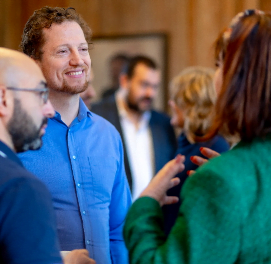
TPC Leadership develops leaders with a heart for leaders AND their organisations. They are engaged and passionate in what they do. They focus on the individual, but will always keep the vision and objectives of the organisation into account.
Janna Kramer, Learning & Talent Development Leader
EY – NETHERLANDS
Use our site switcher to easily navigate between our different offices (in your preferred language where available), or select “Global” for our head office.
The Country Leadership Team, together with the CEO of a large professional services organisation and operating in a very competitive landscape, felt they needed to better equip their Directors newly promoted to Partner, with the leadership skills required in the transition to their new level of responsibility. Although they were provided with information around roles, targets, rules, regulations, etc., they were underequipped in leadership skills as there was still a dominant culture of ‘command and control’ with expertise being recognised, rewarded and promoted, not necessarily ‘leadership’.
Objectives
To foster peer solidarity & strong bonds in a cohort of Partners in order to inspire, grow and learn from each other throughout their careers
To infuse the new Partners with a mindset of being change agents, to be the ‘new blood’ in the organisation, as explicitly required by the Country CEO
To equip all Directors, newly promoted to Partner, with the required leadership toolbox
Interventions
The programme is managed by two TPC Leadership facilitators and a number of coaches. TPCL work closely with the client’s HR and partner relations teams, who supply input and the set objectives for the programme. The continuous redesign was entrusted to TPCL. Each programme is tailored to the current client needs and is key to the programme’s success.
To date, TPCL has successfully guided and coached a large number of Partners during multiple (annual) cohorts, starting in 2018. Cohorts are purposefully kept intimate to ensure a personalised journey for the entire 12-month cycle. The cycle is launched with a kick-off and encompasses three individual coaching sessions and three times two-day (off-site) training camps.
Each training camp dives deeper into key leadership development topics, namely:
Training Camp 1: Personal Leadership,
Camp 2: Team Leadership and leading change
Camp 3: System Leadership
TPCL regularly touch base with the client throughout the cycle during feedback/feedforward sessions.
The organisation saw the value in TPCL’s unique approach to facilitating, with human-to-human interaction and sharing personal experience being central. They also accepted and understood the reason for three coaches, none being facilitators, to guide the Partners in private coaching sessions, the intimacy allowing an even more open relationship in a psychologically safer space. The Partners could comfortably discuss moments they were triggered during the facilitation sessions and in day to day situations.
Working with such a dynamic, incredibly busy group of new Partners has its challenges. Managing their mental and physical presence to ensure they could all be together in the same room for more than 15 minutes, was only overcome by mutual commitment and trust in the process. Partners were eager to continue the programme remotely, following the long interruption created by Covid-19, highlighting the value the Partners had felt being together, despite the hurdles. In the session on Team Leadership, TPCL facilitators act as team coaches, observing the cohort, assessing the Partners working on a real project driven by the country leadership team. The facilitators are able to share their observations at the end of the real play session. The session on Systemic Leadership takes place directly after their annual meeting with all Partners. They had received pre-work observation questions to encourage them to observe and analyse their own system within the bigger organisation which serves as valued real-life input for their training.
Outcomes
The annual programmes, each spanning over 12 months, allows TPCL to form close relationships with the Partners. They are transformed individually, their perceptions of the new roles changed in positive ways. It became transparent to each of them in mind-shifting ‘A-ha’ moments that a Partner is not just a super director but leads teams and has to inspire and engage people. The confidence in and success of the leadership programme has allowed TPCL to return to the client year after year, offering training which is in fact an accompanied walk – the metaphor used by our client is one of mountaineering: base camp is the kick-off, training camps are the three modules – TPC Leadership were the Sherpa.
“The sessions were a great experience and have definitely delivered a lot of food for thought. I definitely think we should maintain this format for future cohorts.” feedback from a participant and Partner.
To learn more about this case or other interventions of relevance for your organisation don’t hesitate to get in touch.
In this blog TPC Leadership founder Charles Brook discusses the need for better leadership development for emerging leaders. It’s essential to ensure emerging leaders are equipped to lead in the new working environments that are rapidly becoming established.
Every organisation plans for growth, but not everyone attains it.
Leadership development for emerging leaders is arguably the most pressing challenge facing organisations today. A report by Deloitte in 2019 revealed that 86% of companies believe the situation to be ‘urgent’ or important,’ yet only 14% claim to develop global leaders excellently. This is not something that we can easily overlook.
At first glance, with $40 billion invested annually (according to Boston Consulting Group), leadership training in the present moment can seem a bloated affair. But the flipside is seen in the financial results of those companies rated strongest on BCG’s 20 leadership and talent management capabilities – they increase their revenues 2.2 times and their profits 1.5 times faster than the companies rated weakest.
A new people strategy is critical
The expressions “to get the best out of someone” and “your hidden potential” imply that more lies within the person waiting to be released.” – John Whitmore
Here’s the thing. Employees say that developing their own leadership skills is the No.1 reason for staying with their organisation. Unless companies are willing to confront their approach to leadership development, their leaders will migrate elsewhere, searching for an opportunity to become something more.
Every seed wants to grow. Although defective seeds do exist, it is usually other conditions – the soil, the light, the space – that determine whether growth is stunted or explosive. When our people strategy is off kilter, our organisations will be hollowed out by the migration of frustrated leaders. More than that, we might struggle to attract anyone with the same level of potential. So how do we make sure our leaders can grow?
Looking beyond traditional leadership skills
“Organisations have grown skilled at developing individual leader competencies, but have mostly ignored the challenge of transforming their leader’s mind-set from one level to the next. ”– John McGuire and Gary Rhodes. Transforming Your Leadership Culture, The Centre for Creative Leadership
When we think of developing leadership skills, what are we imagining? Does our mind jump to management techniques and theory? Or persuading people to be more like a particular personality type? What does real growth actually look like?
If the growth of our organisations is to be secured, we need leaders who are ready and willing to upgrade their way of thinking. For their emotional intelligence to be increased at the same time as their understanding of key principles. We cannot simply add more knowledge on top of existing knowledge. Otherwise nothing will truly ever really shift.
It is this deeper, emotional level of development that creates in leaders the capacity for creative risk-taking, powerful communication and the ability to thrive under pressure.. As John McGuire and Gary Rhodes explain, “Today’s horizontal development within a mind-set must give way to the vertical development of bigger minds.” To get an idea of the kind of leadership coaches that can achieve this, check our 15 signs a coach can deliver what they claim.
Creating room for the exponential
Managers tend to be too risk averse: they focus on the costs of investing in bad ideas rather than the benefits of piloting good ones.’ – Adam Grant, organisational psychologist. Originals
Although you can predict the effect leadership development will have on an individual, you can never truly estimate the impact it will have on the organisation. Ultimately, the greatest organisations to date have been formed because of the quality of the people within them – it is the people who determine the strategy, develop ideas and solve problems daily: The best ideas can come from anywhere.
If we are content to trundle along, expecting the next five years to be much like the last, then maybe we can afford to keep on keeping on. But if we desire to grow, if we long to make a real impact in the world, we have to invest in the leaders and emerging leaders within our organisations.