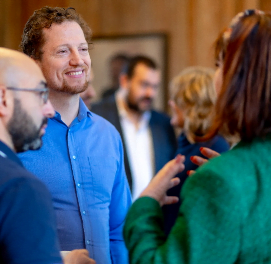
TPC Leadership develops leaders with a heart for leaders AND their organisations. They are engaged and passionate in what they do. They focus on the individual, but will always keep the vision and objectives of the organisation into account.
Janna Kramer, Learning & Talent Development Leader
EY – NETHERLANDS
Use our site switcher to easily navigate between our different offices (in your preferred language where available), or select “Global” for our head office.
“It is extremely powerful… just simply to have the courage of saying, you know your stuff go and do it”.
In this episode of The Leadership Sessions, Tom Van Dyck and Mercedes Alonso discuss the challenges and benefits of diversity, the meaning of authentic leadership and the opportunity of having the patience to let different opinions and different experiences influence decision making.
The Leadership Sessions is a podcast series of captivating conversations with exceptional leaders from around the world sharing their insights, experiences, thoughts, and personal opinions about what leadership means and what it takes to be effective.
Tom Van Dyck, Senior Partner at TPC Leadership
Mercedes Alonso, Executive Vice President Renewable Polymers and Chemical s at Neste.
TPC Leadership is a dynamic global partnership specialising in leadership solutions that deliver cultural transformation and financial impact. With offices around the world, covering 100+ countries, a network of 350+ partners, consultants and associates from diverse professional and cultural backgrounds, TPC Leadership delivers transformational leadership solutions in service of people and business results.
Neste, based in Finland, is the world’s leading producer of sustainable aviation fuel and renewable diesel, and works on solutions for the chemicals and polymers industry to address global issues, such as plastic waste, pollution and climate change.
On your personal take on leadership:
”leadership is truly about people about the teams that you have”
“It is extremely powerful… just simply to have the courage of saying, you know your stuff go and do it, if you need something, I’m here to help”
On authentic leadership:
“…if I, as a leader, have that belief and the purpose and you take it seriously, and everything we do is guided by that purpose… that’s showing authentic leadership.”
“the people, when they are so engaged, when they see that they are doing something with meaning and purpose that their leadership also see them as people and not just as employees, then they give the best…”
On diversity:
“when you have so much diversity, what you have is as well as an enormous richness of different opinions and different experiences. And they do not always converge… so it requires a much more active style of leadership…”
“we want to hire a balanced approach but what we see is that then we attract a lot more of different talent. People that do believe in diversity people, that see that they don’t need to fight for equality because it’s obvious”
“we have a lot of fun working together, we cherish these kinds of different ideas and hearing what the others have seen in their careers or what they think”
“using that diverse team to understand where we’re going in the business, I truly think that that’s what is making the difference”
On what you would say to your 25 year-old self:
“enjoy what you have, exploit it, and then just listen to yourself”
If you wish to share comments or a specific topic that you would like us to cover in a podcast, drop us a line on [email protected]
In our 3rd blog in the series, ‘Diversity is given, Inclusion is a choice’, Annelieke Jense and Frouke Horstmann provide practical ways based on their experience working with clients on how organisations can create a true inclusive culture by installing processes that mitigate unconscious biases.
A hundred years ago, women fought for the right to vote, needing to justify why their voice also counted. Today the USA has a black Asian woman as vice president.We have indeed come a long way! But now is the time to drive home hard that we still have a long way to go to having a fully inclusively diverse culture as the norm, not the exception.
Inside office jokes, not understanding your colleagues when they chat in a language you do not understand, team meetings held on days when you do not work or not in your time zone, starting meetings without all colleagues present, consistently recruiting similar types, made to feel silly for not knowing the cultural norms, not being able to enter a building or attend an event due to disabilities not been taking into account, not starting from an assumption of competence due to race, gender or culture – if you have observed or experienced any of the above, you have encountered unconscious bias in the workplace. And more than likely none of these scenarios were not done with any ill intent, just like the last time you discussed your weekend with a colleague and didn’t involve the foreigner in the canteen.
So how can an organisation ensure true diversity and inclusivity?
When working with clients on how to mitigate unconscious bias, we like to use the word ‘nudge’ – moving people in the direction of inclusive behaviour without convincing them. We help them set their mechanism default in such a way that they choose the right inclusive behaviour because mechanisms, by default, usually invite in-group favouritism.
Throughout your career, the decisions to attract, develop and retain people are underpinned by HR processes and mental decisions often, without bad intent, built on unconscious biases and therefore excluding many people from the beginning.
An example is the Organ Donor drive in The Netherlands.At first people were asked to opt-in, stating they would be donors.But the system was based on the hardwiring of exclusion, discussion in our first blog, and did not generate participation no matter how hard the marketing efforts.But last year the government changed the law and by default you are a donor, unless you opt-out.
This shift can also be made on an organisational level when developing people, for example assessing promotions. The default question asked of managers is usually, Who is promotable? By changing the default to everyone is promotable, the argument is then who is not promotable and by doing this, more women are promoted.
Another example of how changes in the HR process can nudge others to inclusivity is instead of convincing leadership that you must have a D&I policy, ask the managers to argue why not!
‘Blind’ recruiting, i.e. removing personal information such as age, sex, nationality and even the applicant’s name from candidate applications during the assessment process is also apositive nudge in removing bias from the hiring process. This would also include the question “are you internationally mobile”, which often excludes people with young children.By changing this question to “would you consider an international assignment sometime in the future?”, you are automatically more inclusive.
If organisations are in favor of quotas, rather work with, for example, a maximum 70% homogeneity target.
We invite you to follow us on LinkedIn, check out our blog page for original content and actionable insights or contact the authors (Annelieke Jense & Frouke Horstmann) to continue the discussion.
Copyright TPCL
In our first blog in the series on Diversity & Inclusion, we got a better understanding of how we form our unconscious biases and the various dimensions, often not visible, of diversity. In part 2 from ‘Diversity to Inclusion’, Annelieke Jense & Frouke Horstmann focus through the lens of the organisation and shares how to create an inclusive organisational culture.
How our mindset towards diversity has changed
Over the decades our attitude towards diversity and inclusion has changed, much like our mindset about the right leadership style has changed. We have moved from a top-down command-control style versus virtual, empowerment and/or network leadership styles as in our current situation.
Humankind started with a monoculture mindset, evolving through significant changes, maturing to our current intercultural drive for greater diversity and inclusion.
During our monocultural mindset ‘episode’, we were in denial and unaware of cultural differences, not with bad Intent but with limited exposure to different experiences we had a limited view. People were just simply not aware of all the factors involved in an open diverse inclusive culture. The initial stage of realisation was actually one of polarisation in line with what Frouke mentioned in our first blog; the ‘us’ vs ‘them’. Defences of our own personal practices start to play out, certain cultures started taking on a superior role above other cultures as we judged the perceived differences.
This moved to minimisation which was a big improvement as it highlighted commonalities as we started to de-emphasise differences. But it still lacked the real understanding and appreciation of differences. The real intercultural mindset came with acceptance and adaptation. Acceptance, where we recognise and deeply comprehend cultural differences, showing an eagerness to learn and self-reflect and adaptation where we bridge across differences and shift our mindset and behaviour accordingly. This has resulted in today’s ambition for an intercultural mindset, in which we fully embrace cultural differences.
The best is that it implies that our mindset around diversity AND inclusion can change. Hurray! We have come a long way but we are not there yet.
The business rationale for Inclusive Leadership
A topic often linked to diversity & Inclusion is the business rationale for an inclusive organisational culture. In a recent McKinsey study, research clearly showed a marked increase in performance in diverse workforce companies; gender-diverse companies outperforming by 15% and ethnically diverse companies outperforming by as much as 35%. However, the studies show there is still an under-representation of women (23% white women), significantly so for women of colour (only 6%) and men of colour (only 13%) in senior ranking positions.
It is fair to say these results are disappointing and not a true reflection in representing our diversity. These important issues have been on the agenda for years, but we seem to be stuck.
What it seems to show is the business case is not enough
There is an implication that there must be economic grounds to justify investing in people from underrepresented groups. But why should anyone need an economic rationale for affirming the agency and dignity of any group of human beings? New studies show that making the economic business case with the focus on financial benefits, diminishes the sense and the strive towards equality.
It will be the voice and core values and purpose of the business leader that will need to be heard as we, as individuals, stand behind this. In our final chapter in this series, we will discuss the personal dimension to diversity; how to embrace diversity and inclusivity on a deeper level as individuals and leaders.
We invite you to follow us on LinkedIn, check out our blog page for original content and actionable insights or contact the authors (Annelieke Jense & Frouke Horstmann) to continue the discussion.
Copyright TPCL
By Annelieke Jense & Frouke Horstmann
The Dimensions of diversity
There is so much more to diversity than the obvious, like are we male or female, the colour of our skin, our nationality and what we find interesting. We each have a wide range of dimensions, some are internal dimensions, such as your gender, age, physical ability and sexual orientation. We also have external dimensions, for example your social status, education or location. We then have dimensions around an organisation; your role, function, political affiliation, seniority or experience. And the list goes on.
Whilst only a little bit is visible to others, as in the image above, those identifications are so important. In a way they help us define ourselves and give us a sense of who we are. They underlie how we think, how we behave, how we perceive situations and others. Thus it is really important to realise what dimensions we gravitate towards, what do you find important.
Frouke for example, identifies with the full-time working mom and feels part of the pragmatic generation. And based on her experiences this past decade, Annelieke identifies strongly with entrepreneurship and her education as a psychologist.
The ‘power’ of identification
An extreme example of identification was the recent incident involving a teacher being trampled in France. On the bottom line, this had to do with identification in the belief of freedom of speech and an identification in religious beliefs. It showed how our identifications can lead to misunderstandings with others when our core values and the basis for identification clash.
A negative consequence of self-identification, is we tend to see “others” as not only different, but opposite to the views we hold. Frouke, identifying as a pragmatist, could find those who are not, slow or long winded. As a full-time working mom, she could assume mothers not working full time, as having more time for themselves. Mothers not working full time could again assume Frouke is not as close to her children.
Annelieke, a driven entrepreneur, could assume people who do not work as being spoilt with an easy life and could even be jealous of what she could assume is a predictable life, unlike entrepreneurs who can never be completely prepared for the future. We all have an assumption about people that are not “you”.
We human beings, unconsciously and not necessarily with bad intent, try to make sense of the world. We are looking for patterns to make meaning out of all we see and experience. Unconsciously, we tend to fit ourselves into an “in” group and place others in an “out” group. What happens when we view people as “in” or “out” groups, is we see people in the “in” group, as very different, even unique, yet generalise about the people in the “out” group, seeing patterns.
In your “in” group you feel comfort, warmth and trust and can behave intuitively. With your “out” group, you are more on guard and ready to disengage. An example of this homogenous view of the “out” group, is the discomfort Frouke feels when training people from Asia as she struggles to link names to faces – a discomfort also held by her Asian colleagues who have the same struggle telling her and Annelieke apart!
We all have unconscious biases about others, and not with bad intent. What we consider as “right” behaviour, as part of our culture and our unconscious biases, are not seen but have a direct impact on our emotions. This is evident when we consider the strong emotions felt by those, where religion is very important, over a cartoon depiction of the Prophet Mohammed and for those who do not see it as important, it evokes no feelings. Based on the strength of our emotions, we display different behaviours.
And the thing is, we are not wired for inclusive behaviour, but exclusive behaviour! Inclusive behaviour is tiring and leads to fatigue.
Awareness about diversity is not enough
The reason we emphasize this point in the journey from diversity to inclusivity is that only increasing a diverse workforce does not automatically guarantee it will produce benefits. There are many factors to consider to minimise the drain on your diverse workforce.
Companies will benefit if leaders:
Create a workplace where people feel safe expressing themselves freely
Combat forms of discrimination and subordination
Embrace a wide range of styles and voices
Make cultural differences a resource for learning
Only then will you really benefit from it.
We see & experience diversity all around us – diversity is a given
Inclusion is behavioural – inclusion is a choice
A deliberate choice you need to make, putting in the effort to override our hardwiring, as your choice impacts the company’s culture.
In our next blog in the series on Diversity to Inclusion, we will discuss how to set an inclusive organisational culture. We invite you to follow us on LinkedIn, check out our blog page for original content and actionable insights or contact the authors (Annelieke Jense & Frouke Horstmann) to continue the discussion.
Copyright TPCL
Has COVID-19 changed the make up and functioning of the boardroom? Or has it merely held up a lens and made us focus on what has been evolving gradually for some time? Perhaps the pandemic has shown us where more change is still needed if businesses are to survive and thrive in a post-pandemic world. Whatever the case, the world has changed and that means staying still isn’t an option.
With experience working across a range of organisations in numerous countries across the globe, TPCL’s partners and associates have seen up close the challenges and the opportunities facing leaders over the last few months, the things that have changed and those that still need to.
Last month we kicked off a series of articles on leadership based on panel discussions with TPCL’s managing partners from around the world. In today’s post we’re focusing on the boardroom and how it has or hasn’t changed over the last few months.
Contributing to the discussion are TPCL founder Charles Brook, and managing partners Paula Abramovicz Erlich from Brazil, Frouke Horstmann from the Netherlands, and Laurent Jacquet from Belgium.
Working together to solve problems
The role of a board of directors is, when you boil it down to a single definition, fairly straightforward – to look after the interests of the business or organisation, its shareholders and its stakeholders.
What this actually looks like in practice, however, is likely to change over time. And in the case of a global crisis like the current pandemic, it may shift more rapidly than at other times. So has that been the case this year?
Laurent Jacquet, managing partner with TPCL Belgium, believes that one way the pandemic has impacted boardrooms is by increasing the focus on leadership diversity – even if the theory has been slow to translate into practical action.
“The vast majority of people in boardrooms are there because it serves the business,” he says. “But there is an increased awareness that greater diversity in these boardrooms is required and can be overall beneficial.”
“As an example, the Belgian government’s COVID-19 working group was initially only made up of health experts and political people. Then they thought, ‘Is this sufficient? Shouldn’t we ask other people to join this expert group?’ Because it’s not only about health; they understood that it would be wise to have different perspectives.”
Resistance to change at top level?
While specific problem-solving task groups may have demonstrated an accelerated move towards diversity of expertise, in the boardroom progress hasn’t always been as fast, especially in relation to gender diversity and ethnicity.
Paula Abramovicz Erlich, TPCL’s managing partner in Brazil, says that change has been slow – and the pandemic hasn’t done much to accelerate that.
“There has been a movement to try to include more women in boards over the last few years, but it hasn’t been extremely successful yet,” she says.
“There’s resistance around getting quotas. I think quotas are a temporary mechanism that help you ‘fix’ an inequality in the short term but don’t solve the problem. There’s still a lot of prejudice around getting women on boards.”
Charles Brook, TPCL’s founder, agrees that it’s a challenge but believes that quotas can be helpful in changing cultural norms.
“It’s a hard nut to crack because people like people that are like themselves,” he says. “It’s very easy, as the CEO, to recruit in your own image. And yet we all know diversity is important.”
“I know some people will see this as controversial but in countries where they have enforced more gender equality on a board, I personally think it is a good thing. Because we have to break the norms.”
The world is demanding diversity
One important business reason for increasing diversity at board level is increased pressure from wider stakeholders.
Charles says: “For some of my clients in the consulting world there’s been a very strong push from their clients to have wider, more diverse representation. So it’s becoming more client led, where clients are really having to be heard.”
Frouke Horstmann, TPCL’s managing partner for the Netherlands, agrees – but acknowledges that balancing stakeholder interests is a real challenge for board members.
“There’s a lot of pressure from society for boards to be more focused on not only profit creation but real value creation. The pool of stakeholders has broadened so it’s not only about focusing on the shareholders who put in money in your company, but all people.”
“There’s more focus on purpose and planet, more B Corp organisations – not just the smaller businesses but bigger ones like Danone in the US. The problem is that some boards really get on board with this but then the more old-fashioned shareholders do not always buy into that. So there’s this real tension for them.”
Of course, representation – having the ‘correct’ number of women, ethnic minorities and so on at board level – is just a first step towards true diversity.
“It’s one thing having a diverse group of people in a boardroom and then there’s how much space they get to share their views and how much their views are valued and acted on,” says Charles.
“One way I believe COVID has positively impacted on diversity is that many board meetings, if not all, are happening virtually now and I’ve noticed that people are having more of a say because of that. Technology is more or less forcing more people to have a voice. It’s harder to sit in a room and just talk over other people.”
In fact, restrictions on travel and the resultant increase in remote meetings thanks to the pandemic may well mark a long term step change that allows a wider pool of people to input into what might once have been more local conversations.
“People are starting to say, ‘I’m not traveling for a four-hour meeting. This is working fine over Zoom.’” says Paula. “Board members don’t all necessarily live in the same city, so we may see more representation of different countries or cities coming together more easily.”
Operations vs strategic focus
Another change that TPCL’s leaders have noticed since the pandemic started is the shift from strategic discussion to more operational conversations. This, our experts warn, is natural but could be dangerous in the long term.
“The current situation is forcing more tactical conversations to be happening in the boardroom, because things are changing on a day-to-day basis,” says Charles.
“There’s less and less time spent stepping back and looking at the big picture and wider system. Less and less time spent on the why. Why are we here? How can we engage with the ‘why’? I think that’s an issue, albeit a downstream issue.”
The problem with prioritising operations over strategy is that it can be all too easy to lose sight of the organisation’s vision. This can filter down into every level of the business, ultimately resulting in a disconnect for the very people who keep the business operating on a day to day basis.
“Due to the crisis a lot of boards are in survival mode, either just holding on in there, trying to survive or at best trying to see how to create opportunities,” says Laurent. “That means that wider systems and purpose have been put a little bit on the side. But people need to put that back on the table.”
“I’m talking to a lot of people who are saying, ‘I’m actually starting to disconnect from my organisation, because if I work for A or for B, there’s no difference. I’m working from home in front of my computer and that sense of belonging is starting to fade away.’”
“It is that risk of lower engagement and difficulty in holding onto their people that puts the purpose and the why back in front of the boardroom table. They may be in survival mode but they still need to keep that in mind.”
In part two of this discussion featuring Charles, Frouke, Laurent and Paula, we’ll pick up on the theme of employee engagement and explore the important subject of culture. Keep an eye out on our social channels or sign up for our newsletter to stay up to date with the latest insights from TPCL’s Leadership experts.
Contact us to learn more about how we can help or check our leadership consultancy services.
@copyright TPCL (2020)
In this blog we talk to TPC Leadership Associate Partners Catherine Bardwell and Valeria Cardillo Piccolino about how to manage virtual teams and in particular cross-cultural teams.
Inclusion often encounters resistance among those who consider it a passing HR trend and feel the voice of the diversity and inclusion (D&I) advocates is too paternalistic. But often this resistance exists because we lack perception of the ways in which we are non-inclusive.
While it’s true that only a few people are intentionally non-inclusive, unless we approach inclusion from all angles, employees won’t necessarily feel included, nor will the true creative potential of our organisations be realised.
For cross-cultural teams, when commonly overlooked voices begin to be heard, the results can be dramatic. As Kim Belair of Sweet Baby Inc. said in a panel regarding interactive media, “representation has the potential to be as innovative as new tech.”
“Cross-cultural virtual teams have become the norm in many corporations,” says Catherine Bradwell, Associate Partner at TPC Leadership. “Yet we still underinvest in cross-cultural skills necessary to create high-performing teams.”
Therefore, “for the deeper work to happen, inclusion cannot remain HR policy,” says Valeria Cardillo Piccolino, a TPC Leadership Associate Partner. “It must involve all leaders.”
“Let me explain,” says Catherine. “Do you hear your people say: ‘Lack of participation’, ’no decision-making’, ‘boring meetings’?” If so, they may be misdiagnosing the situation.
“Some cultures may tend to be comfortable taking the lead in a group conversation,” says Catherine, “But other cultures are less inclined. Now is the time to understand different perspectives and how to best adapt one’s own style to better lead cross-cultural virtual teams.”
Grow in awareness of cultural norms
“In any culture there are certain ways of behaving that are considered dominant,” says Valeria. “These dominant traits shape what we perceive to be polite or acceptable. And they create filters that affect our understanding of others and the wider world.”
A common difference in dominant culture characteristics is that of introversion vs. extroversion, for example. For in some cultures it is considered rude to interrupt or express dissent, while in others forthrightness is perceived to be a sign of confidence and strength. This affects people regardless of their personality.
“Your personality determines how you WANT to behave, culture determines how you SHOULD behave,” says Csaba Toth, developer of the Global DISC framework. Personality still plays a part, but an extroverted South Korean will still act differently to an extrovert born and raised in Amsterdam.
Grow in awareness of unconscious bias
It affects all leaders and teams, but unconscious bias can become acute in virtual teams. In our pursuit of efficiency – and desiring to keep our fifth zoom meeting that day as short as possible – we default to the path of least resistance.
“Micro affirmations or micro-behaviours create a barrier to inclusion, even more so because they act at an unconscious level” says Valeria.
One example of a micro-behaviour is not involving certain colleagues in a challenging and strategic project because we perceive them as ‘not fitting.’ And this could simply be because they are very different from the dominant, inner-circle culture. The problem is that, in the majority of cases, we won’t be aware of our internal logic and we will just follow our ‘managerial instinct’ or, ‘the gut’.
“Biases form from existing relationships, and without realising it, we find ourselves working with, listening to and handing strategic responsibility to the same few people. This is the effect of ‘affinity bias’ or ‘similarity bias’. We like people whom we perceive similar to us.”
Unconscious bias by its very nature is not malicious or intended, but unless we deliberately act to include – forcing ourselves to be curious, discussing the effect our actions could have on someone with a different set of values – we will continue to create exclusive inner circles of trust, populated by people like us. And we will inevitably overlook and miss out on the full range of competencies in our teams.
HR can address some issues directly, particularly when it comes to diversity. But inclusion is the responsibility of everyone in leadership. As Brenda Trenowden, the Global Chair of the 30% Club says, “If you throw a lot of diversity at an organization and there isn’t an inclusive culture, it’s not going to stick. So we really need to focus on both.”
Create space in the virtual space
When it comes to leading cross-cultural teams, every detail matters. Whenever someone in our team concedes an argument, or refuses to push back when they are contradicted, we need to ask ourselves, “are the dominant traits of their culture at play here?” Their opinion might be unmoved, yet they may have let the issue go for the sake of politeness. This is just one of the many cultural factors we need to consider.
“Working in a virtual space requires us to put in practice our sensitivity to how different cultures perceive not only our non-verbal or paraverbal communication,” says Valeria, “but also our written communication.”
“As an example of this, someone I coach recently expressed in a direct and assertive way his ‘right,’ to take a few hours leave. The email he sent to his boss simply stated that he was informing her about this.” says Valeria. “But his email, he realised during our coaching session, could have been perceived a bit rude or too direct by his boss, an Asian young woman whom he met not long ago.”
Working virtually is also putting our capability to manage our work and private life under pressure. Managers need to be aware of their own expectations – and whether they are inappropriate in light of the other demands a team member faces.
“Some people have a greater need to switch off,” says Valeria. “And their boundaries need to be respected.” Those from cultures that lean towards compliance are less likely to make these needs explicit, so managers need to pay attention. If they can read between the lines of cultural context, they will know when a team member needs rest.
When managers are trained in interculturality, unconscious bias will hold less sway, and the needs of team members will be better met. Essentially, those who display different cultural behaviours will not be overlooked for having different needs – and the resulting flow of trust will give new and emerging voices the opportunity to shape strategy, spot errors and expand the range of our collective intelligence.
Our teams will be more innovative than ever. Not just because of the steps that HR took. But because of the steps we all took – to see the brilliance beyond our own culture.
Want more insight on how to move forward?Get in touch with usto find out how we can help.
In the first of our new blog series focusing on virtual teams, we talk to TPC Leadership Associate Partners Catherine Bardwell and Valeria Cardillo Piccolino about diversity and inclusion and the importance for virtual teams.
Diversity and inclusion in the virtual workplace
In recent years diversity and inclusion has become a mainstream topic for HR and large organisations. But regardless of how much advocates of diversity and inclusion (D&I) connect with the values, their efforts to bring change are often met with scepticism.
The real question that each business needs to answer when starting a D&I project is ‘What’s in it for us, as a company, and moreover, why is it important now more than ever?’
“Businesses have a choice when it comes to inclusion,” says Valeria Cardillo Piccolino, a TPC Leadership Associate Partner. “They can have what I call a hygienic approach to inclusion – doing it for legal and marketing reasons – or they can tackle inclusion in a deeper way, tapping into the full potential of their people.”
Catherine Bardwell, a TPC Leadership Associate Partner adds, “Working in a company with colleagues and clients from all over the world requires leaders to become very curious. To become sensitive to the many different approaches and filters of perception that manifest from a mix of genders, cultures, ages and personality profiles.”
“And in the virtual space of video-call meetings” Catherine says, “where there is even less opportunity for personal connection… the issue of whether people actually feel included is more pressing than ever.”
Inclusivity requires curious attention
“Corporates that don’t want to just ‘tick the box’ should enact change at different levels,” says Catherine. “They need to create a governance system for inclusion. They need to provide training to make their leaders aware. They need to shape their cultural mindset so they can shift processes and systems, such as recruitment or the delegation of strategic projects.”
If a business is to take these significant steps forward, they need to understand what is at stake.
Scott E. Page explains the dichotomy in The Diversity Bonus, saying that, “A failed business cannot advance any social causes. You know this as CEO, so your primary commitment will be to carry out the company’s mission… building a fair and just society will be secondary.”
Although we might feel justified in having a cause that is untouched by business concern, we create unnecessary friction for ourselves – pitting the bottom-line needs of our business against our ethics and ideals. Despite our noble intentions, our leadership teams and our operations will inevitably continue to prioritise the needs of the business above tackling inclusion. Too often, a business’ inclusion policy becomes a box-ticking exercise.
Inclusivity is about more than reputation
Few are the businesses that do not wish to be seen as inclusive. The ever-improving methods of gathering data allow companies to measure their reputation among their customers and employees more than ever. And inclusivity is shown to move the needle.
A Bain & Company Net Promoter Score (NPS) report shows that “Having a CEO or executive team member who models inclusive behaviour can increase an employee Net Promoter Score by 59%, regardless of his or her own identity profile.”
But a reputation for inclusion does not necessarily translate into actual inclusion. At least not the extensive kind. Although many companies position themselves as inclusive, there is still a visibly lower Employee Net Promoter Score for BAME employees compared to Caucasian. And when intersectionality is taken into account, the surface-level adjustments that companies make are shown up.
According to the same NPS report, among BAME (Black, Asian and Minority Ethnic) women employees, the NPS is at minus 2%. Regardless of how companies are perceived – this is how they feel at ground level from behind a remote worker’s desk… and that is where inclusion matters right now.
Designing inclusive organisation: capitalising on internal resources
Although it may sound bottom-line, the most crucial reason for inclusivity that businesses need to heed is operational. For our levels of inclusivity directly relate to our levels of engagement. “The less included I feel,” says Valeria, “the less I will contribute my ideas, the less I will disagree with a status quo mindset, the less I will correct the mistakes of others.”
This is exaggerated even more in a virtual environment, where the window of opportunity to speak up is small and constrictive.
Valeria poses five questions that, organisations should ask themselves as a starting point for the design of inclusive virtual workplaces:
How are leaders ensuring each team member feels free to express ideas in a virtual environment?
Are team members curious about different styles of communication and expression, or do they try to minimise differences?
How are leaders promoting the expression of generative dissent and divergent opinions, so constructive conflicts can arise and challenge the status quo?
How can leaders and team members promote a collaboration that doesn’t rely on ‘comfortable relationships’ between similar kinds of people? (So that strategic responsibilities are assigned based on a true competencies evaluation and merit)
What processes and systems could enable teams to be a safe space to contribute and learn, for each one of its members, now that our ways of working have been revolutionised by Covid-19 crisis?.
There are gaps in our organisations. Places in which the potential of our teams remains untapped. Unless we realise how diversity and inclusion is directly related to this matter, we will never properly resolve either issue.
There is a greater spectrum of intelligence available to us, if we will just have eyes to see it. Once we recognise what is at stake, we will have to prioritise inclusion. It was always an ethical prerogative, but now we understand that it’s a business one too.
Want more insight on how to move forward?Get in touch with us to find out how we can help.