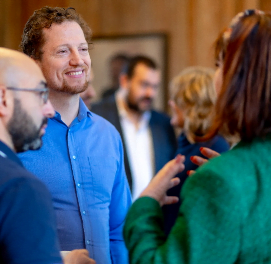
TPC Leadership develops leaders with a heart for leaders AND their organisations. They are engaged and passionate in what they do. They focus on the individual, but will always keep the vision and objectives of the organisation into account.
Janna Kramer, Learning & Talent Development Leader
EY – NETHERLANDS
Use our site switcher to easily navigate between our different offices (in your preferred language where available), or select “Global” for our head office.
Our international client, with HQ in the USA, was experiencing cultural issues within the local country office. There were huge gaps between perceptions and expectations of some of the senior management team and the junior team leaders and staff. It was reported by junior leaders that some of the senior leadership was perceived as creating a toxic culture rather than allowing them space to grow and have a contributory voice. Recognising the different attitudes to leadership, the Manging Director wanted to discuss ways of keeping the junior teams motivated to prevent any further costs in replacing unhappy leavers.
Objectives
To reconnect as an organisation, reconnect as people and move forward in a more positive environment where everyone feels safe and valued, by:
Restoring the culture to be inclusive to all
Guiding the senior leadership through the steps to restore a positive culture
Ensuring the junior team felt validated and motivated to stay on
Preventing the division between staff levels from escalating further and bringing closer together, to reconnect as an organisation.
Our approach
We developed a diagnostic phase, including focus groups, while building psychological safety for all, as well as leaver interviews to understand the rationale behind their decisions to leave.
Following workshops to share the results of this phase and suggest recommendations, subsequent workshops were held to develop a feedback culture. Alongside this we created a framework to enable regular 360 peer feedback.
Having an external facilitator gave the HR team the bigger picture perspective. Both junior and senior leaders were further supported with 1:1 coaching when asked for.
Outcomes
All staff saw the tangible commitment from the organization to ensure measures were in place to foster a healthy company culture. The office created a charter, reflecting their local company values. Through TPCL run workshops, they gained the skills to translate values to behaviours, focussing on meaning and purpose.
Feedback
A lasting effect of the programme was that people dared to speak up more as trust was being restored, ensuring staff felt motivated to commit to their career at the organisation.
To learn more about this case or other interventions of relevance for your organisation don’t hesitate to get in touch
Business context & drivers for the organisation to do the project
The organisation was undergoing a reorganisation and restructuring impacting different teams. The strategic marketing team leader wanted her restructured team to be reenergized, to get in touch with the value they bring to the organisation, to understand the new scope and translate this into a new vision & mission. The team needed clarity on the roles they were going to play, their responsibilities and their positioning within the new structure as they had lost scope, resources, and people due to the restructuring and were left feeling marginalised. Roles they had previously had, were now with another team. To prevent complaints resulting from confusion, and to ensure a healthy new team structure kick-off, the organisation felt it important to partner with TPC Leadership sooner, than later, even though the timing was far from ideal.
Objectives / required outcomes for the client
Embracing the new beginning and setting the team up for success.
Understanding the new scope and translating it in a new vision & mission.
Become a stronger team, spending time together, getting to know each other better
Understand their purpose and what their roles & responsibilities are in the new structure and defining their new position in the organisation to share with the organisation.
Mutual appreciation and recognition of each role and contribution
Alignment on how to bring value to the rest of the organization and their purpose
Clarity on how to collaborate
Interventions
In four x 2hr virtual sessions with intermediate assignments, TPCL delivered a Team Development program to 14 participants on Building an Effective Team. The participants were able to reflect on the impact of the recent changes while exploring ambitions of the team. By setting the scope and establishing parameters they were able to align their scope, priorities & processes, establishing a new team vision & mission and most important were re-energised and proud of their team. TPCL was a thought partner, taking the team leader and team by the hand, helping them navigate this turbulent change being imposed and tackling the frustrations soon in the program. As TPCL had partnered with the organisation at higher levels in the past, TPCL were consultants and intermediaries in smoothing the path to a better relationship with another team, where healthier collaboration was required, by helping them with the new ways of working together. TPCL challenged the team to embrace change even if not fully convinced by it and how to relate to the change and to question what responsibilities it would provide. The team were encouraged to voice their defined roles by creating an elevator& pitch on the value, purpose and position they bring as a restructured team, as preparation to explain their team and their roles to the rest of the organisation.
Outcomes
Based on the participant polls on how much clarity they now had regarding their roles & responsibilities and the energy boost they felt they derived from the program, there was good evidence of success. Although the team initially needed convincing about the potential of virtual coaching, being a large team of 14, and initially the participants would meet together for a full day, now not an option due to lockdowns, all were in awe at the amount quality of output generated in the 4 sessions. The team demonstrated a strong mutual appreciation of each other & roles and much needed clarity on how to collaborate, with a renewed energy boost.
Client testimonial
“…exciting, fun, effective – we had never expected to achieve so much in virtual sessions and in such a short time!”
“what an amazing job you did with these sessions. I am totally bought into online facilitation after this. Everyone has the same air time and can express themselves, and doing it over several days helps reflect and keep momentum. I highly recommend it! ” Marketing director at client
To learn more about this case or other interventions of relevance for your organisation don’t hesitate to get in touch
TPCL Leadership has just turned 20 years old! It has been a long journey since our early training courses and our first clients. We’ve grown into a leading consultancy with a coaching and leadership academy, offices and partners across the globe.
But from a certain angle, it’s not the growth that we’re happy about. It’s that TPCL is still, at its heart, what it was 20 years ago – a culture worth celebrating.
To mark the occasion, Charles Brook, founder of TPCL, and our chairperson, Annelieke Jense, reminisced about the highlights and setbacks of the last two decades – and why the TPCL culture has remained special.
Why people joined TPCL
“Whenever we found that someone wasn’t the right fit,” says Charles, “it’s nearly always been because the values alignment wasn’t quite there. It has been amazing to see how everyone has ultimately been attracted by the culture.”
Annelieke recalls the moment she decided to join TPCL in 2011. She was working for an Amsterdam university at the time and had plenty of reasons not to leave. But having trained as a coach through one of the first TPCL programs, she knew the quality of the professionals who were offering her a partnership role.
“And they weren’t just fantastic professionals but fantastic human beings,” says Annelieke, “I wanted to work with these people I felt such connection with. People who went for impact rather than quick fixes – and whose clients invested in people. And as a result, I’ve always believed I’m in the right profession.”
The challenges of being a TPCL partner
The full tale of how Annelieke became a partner seems like a chapter from a storybook. But finding the right partners for TPCL has sometimes been a much trickier process.
Becoming a TPCL partner is about more than being a leadership coach, or even a consultant. You need to be a business developer who can manage a regional office while taking ownership of the global development of the company too.
“It’s not hard to find good professional coaches,” says Annelieke, “but to find someone who can take a real stake in the organisation and have real equity… it’s like you’re searching for this entrepreneurial sheep with five legs.”
What we can and can’t control
TPCL now has partners and offices all over the world. But like any success story, it comes at a price of setbacks and disappointments. Some international offices simply didn’t work out.
Charles found it easier to bounce back by using a reflection model called the Three Circles, produced by Steven Covey, which asks what’s in your sphere of control, what’s in your sphere of influence and what’s only in your sphere of concerns. The logic goes that if you don’t have any control or any influence over a problem, there’s not much benefit in worrying about it.
“If I walk into my living room and accidentally smash the best bit of cut glass,” says Charles, “I might think, ‘Damn it, that was beautiful. I’m so annoyed that I did it’ but then that’s it. There’s nothing I can do now that it’s broken. And although this mindset means I probably don’t fully learn all the lessons of a bereavement process, overall it’s been helpful to move on.”
The enduring sense of team
The reward of facing such challenges and overcoming disappointments is that TPCL is what it is. Even though the team has been working virtually since long before COVID-19, they have always felt connected to one another and the work each partner is doing.
“Only our Italian and Netherlands branches actually have an office,” says Charles, “And still there’s an amount of affiliation which I don’t think other organizations have got yet, even though we’re a virtual team. So I’m super proud of that.”
There’s also a real desire in all the TPCL partners to leave a legacy, whether it is about climate change or reducing poverty or supporting global SDGs.
“It’s about wanting to make a difference,” says Charles. “And finding other people who want to make a difference with you. This is what happens when you attract people to the cause through your values. You end up with a team that wants to do projects for the third sector, for the United Nations and for women leaders in Ethiopia.”
Playing the long game
When reflecting on what has made TPCL work so well over the years, Charles believes that they have opted to grow only as quickly as their values allow. And one of these values is to relentlessly do what is best for the client, even if it means losing business.
“I remember turning down a huge global project,” says Charles, “and the company was beside themselves. They wanted to change their company culture to make it a coaching culture and they wanted to do it by running two-day workshops around the world.”
Charles had said to them, “What is it you really want? Do you want to help people have some coaching skills?” But they said, “No, we want a coaching culture.” So Charles laid down the facts: “You’re not going to do it by running two-day workshops around the world. That’s not going to change your culture.”
And even though this company said they were committed and had set a budget of over a million pounds to achieve it, Charles told them it simply would not work. And so TPCL never saw their business.
But other companies saw TPCL’s restraint as a sign of trustworthiness. Annelieke recalls that when she asked several of our clients, “Why did you choose us?” They said, “You were not pitching. You were just asking the right questions.”
The future of TPCL
As we look back on 20 years, there is a lot to celebrate. And there is also a lot to look forward to. But while TPCL is readying to grow globally and become more sustainable in each local office, Charles’ hopes for the company he founded are primarily to do with its culture.
“More than anything else I want it to be a home for people with like-minded values, where they can live and be the person they want to be,” says Charles.
“Because in many organizations you have to conform to fit in. And you don’t feel you can be who you are, live the life you want, make the difference you want. So I would love for us not to lose that in the next five or 10 years. For people to still come because they can find a place where they can express themselves and live their potential.”
So here’s to the next five, 10 and even 20 years of TPCL. And if you want to learn more about creating or sustaining a company culture, don’t hesitate to get in touch.
@ TPCL (2021)
Leading a business has never been easy but the events of the last few months have been more challenging than anyone could have predicted. For those sitting at board level, striving to steer their organisations through the changes that have resulted from the COVID-19 crisis, it has been a time of rapid and unprecedented learning.
As leadership coaches and consultants working with a range of organisations around the world, the team at TPC Leadership have seen first hand the impact the crisis has had. Over the last few weeks, our managing partners have been getting together virtually to discuss the key issues in a series of panel discussions.
In this week’s blog post, we join TPCL founder Charles Brook and managing partners Paula Abramovicz Erlich (Brazil), Frouke Horstmann (Netherlands), and Laurent Jacquet (Belgium) as they look at the role culture plays within a business, how it has become even more strategically significant thanks to the pandemic, and what leaders at board level can do to ensure they set and communicate an effective culture within their organisations.
Change, communication and employee retention
Most people don’t like change, especially when it might impact their security. When the pandemic hit, a lot of people were naturally very frightened. From how to adapt to home working to the worries or whether or not they’d have a job by the end of the year, employees had a lot of questions. In many cases these questions remain unanswered. And for business leaders this can have a negative impact on morale, productivity and ultimately retention.
Frouke Horstmann and Laurent Jacquet, managing partners for the Netherlands and Belgium respectively, have recently worked with a client on a culture project. Concerned about the number of people leaving the business, they asked TPCL to help them understand why people might be leaving.
The answer was simple: lack of communication. Despite having all the right intentions to communicate their plans, the leadership team had been holding back until they had all the answers. Ultimately they had decided not to let anyone go – but in the meantime, people had been scared of losing their jobs and so had decided to move on.
“The younger population – the whole world – is 24/7 these days, communication is 24/7,” says Frouke. “So even if you don’t know the answers, you have to be communicating with people, you have to let them know as far as you can what you already know, what you don’t know, what your ideas are.”
And it’s not enough to communicate practical plans either. In times of crisis the temptation is to focus on operations and ignore strategy, but setting and communicating an organisational vision is especially important when everything else is so uncertain.
“There has to be a reason for people to want to stay,” says Charles Brook. “And organisations that don’t help people connect with what they’re doing, to the reason why the organisation is there and why they as individuals are there – that meaning and purpose – are really going to struggle.”
This is particularly important in a work-from-home context, where staying connected to an organisation, its vision and its culture is that much harder. People need to know that the effort they’re making has an impact and that they have a place within a wider context.
Charles adds: “Many organisations are understandably trying to leverage performance and productivity when it comes to home working, but they sometimes don’t realise that another cost is people disconnecting. To attract and retain talent it’s important that they feel connected.”
Protecting connection and culture in a virtual world
There are benefits to remote working when it comes to talent. Without the need for people to be physically present in an office, employers can widen the net, hiring from further afield – even abroad. The accelerated new ways of working have also opened people up to different hiring approaches.
Frouke says: “The discussions CHROs are now having is, ‘Okay, maybe we don’t need to always have people on the payroll. We can think in project terms and we can take that talent for six weeks, for two days and we can bring in someone from Singapore and someone from China and someone from Amsterdam, because they have the talents that we need now.’”
But attraction and retention remain a factor. With teams not coming together physically, how can employers ensure there is a consistent and effective culture? How do we get people to buy into an organisation and gain a sense of belonging if they work every day in their own home?
“With everyone working from home we’re just having meetings, we don’t talk around the water cooler,” says Paula Abramovicz Erlich. “There’s no spontaneity. Nothing comes around of meeting in the halls and having a spontaneous idea. There’s no chit-chat in the beginning of meetings, we always go straight to the point. So what happens to culture?”
Further reading: Employees working partially from home and in the office: how do you connect your team? By Frouke Horstmann
Can culture be created – and if so, how?
For the leaders in charge of newly remote organisations, the issue of culture leads to two foundational questions – is it something that can be created and, if so, who is actually in control of that process?
Laurent Jacquet believes there are only two options – either you do nothing and a culture develops organically, or you decide on the culture you want and you communicate that down through the business.
“What are our values? How do we want to communicate? How do we want to take decisions? How do we want to work from home? Setting culture is about all of these things,” he says.
“For me, culture should be top-down – but you should of course be inclusive and listen to what everyone is saying in terms of their interpretation of the culture. My belief is that culture stems from the founder.”
In large organisations putting that into practice takes effort – especially where teams are split across different locations. If a board is setting a culture behind closed doors but failing to communicate that then it simply won’t be effective.
“It’s always down to the leadership,” says Paula. “The leadership needs to role model what the culture is, what they want everyone else in the company to do. So if the board doesn’t get the leadership on board, there is no culture change, in my view.”
Role modelling is a vital part of leading when it comes to culture. Frouke, who has written extensively on workplace culture, has worked with a number of board level clients who want to set a feedback culture, for example, but don’t include themselves within the project.
“They want to have a program starting with what I call N-1 – so starting with a level below the board,” she says.
“I find that it is fascinating. If you want to have a feedback culture, is it not the most important thing that you look into the mirror yourself? And that you role model it to the rest of the organisation?”
Communicating and developing culture
Whether a board allows a culture to emerge organically or whether they are constructionist about it and create it from the top, it is vital that it is clear what behaviours are acceptable in order to reinforce that culture.
“In some ways that’s the most important bit,” says Charles. “People need to know what is the right thing and the wrong thing to do in this culture. Otherwise, it’s very hard to get a unifying culture because people will act in different ways.
“We had a partner years ago who was probably one of the best at selling projects, so a very valuable person to have in the business. He wanted to become a senior partner but we have an annual values check where we assess whether our partners live their values and he didn’t pass that so we didn’t promote him. Eventually they had to leave.
“At one level you think, ‘We’re letting go of our best salesperson!’ but on another level if their behaviors are not going to generate the culture you want, then they have to go. And I think making some of those tough decisions is difficult for organisations but ultimately understanding what’s acceptable and not and then acting on it is really important.”
Culture has always been an important part of business success, bringing employees together, encouraging collaboration, improving morale, reducing turnover and having many other positive effects besides.
But in today’s business environment, with so much change and uncertainty, it is more important than ever. For board members and seniors leaders at the helm of their organisations, it is essential that steering the ship does not take priority over setting a course and communicating it to the crew.
Have you enjoyed this article? Be sure to catch up on the rest of the series:
How leadership is changing – and how it needs to change – in a post-pandemic world
Communication, resilience and embracing uncertainty – leadership lessons for a post-pandemic world
Boardroom evolution – what’s changing and what part has the pandemic played?