After Regen comes Sunshine
Written by Tom Van Dyck, Partner at TPC Leadership BeNeLux
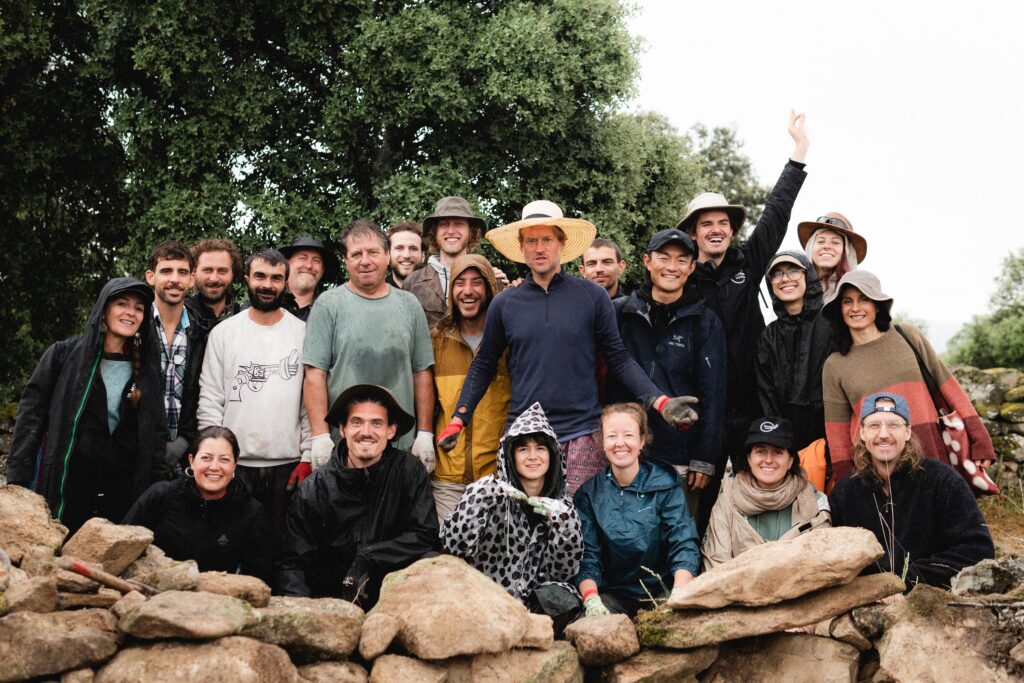
Earlier this Spring, I got involved with Ten Lives – a festival in Portugal that regenerates soil in Southern Europe, fighting desertification through music. The (brilliant) folks from Ten Lives do it with shovels and beats so that dry soil starts re-greening with more water, more trees, more biodiversity. Life returns. While out in the field delivering a leadership training for the group leads (called “Guardians”) of the festival , something sparked: could the same logic apply to how we lead teams?
With the wider acceptance that ‘sustainability’ alone may not be enough anymore, regeneration has been on our mind increasingly across various topics. It helped me connect some dots on many leadership topics we come across on an almost daily basis, serving as an invitation to reflect on how we could make things better again, instead of ‘not worse’.
And here’s the thing: we already do it. Some clients already do it. Many of our leadership interventions are regenerative by nature. We were just missing the language to pinpoint the impact of what we do.
Sustainability vs. Regeneration
For years now, ‘sustainability’ has been the go-to standard. ‘Do no harm’ – the idea that resources are finite and must not be depleted has luckily been gaining traction. Companies, executives, leaders everywhere are now increasingly striving to ‘not make things worse’ by running their business, by leading their teams. That is a commendable direction of travel…but is it enough? Just looking at the people/leadership arena…is it enough to…
- Leave burnout and other mental health issues at current levels?
- Leave disengagement levels where they are?
- Leave the glass ceiling where it is?
- Accept that x% of M&A and Transformation projects fail, at very high financial and human cost?
We can (some say ‘should‘) fix what is broken. We can move beyond Sustainability. We can move towards a logic where we leave things behind in a better place than how we found it: we can re-generate. Beyond the end result, is the process.
Regeneration heavily leans on systemic thinking, going beyond the individual and looking at connectivity and collective power. It recognizes that when things go well, it’s often thanks to the collective effort of many. And when things don’t go well, it’s often not one individual’s ‘fault’ – we need to look at relations between members, communication, and how the system itself is set up.
Today, people crave more social connection, more belonging, and simply feel better in their skin if they are part of something bigger. A regen mindset helps us move away from the era of heroic leadership and shift towards an era of social, meaningful impact.
Regeneration in Leadership, focus on Teams
We can make life return in leadership too; if it’s done right. Credit where credit is due: I first came across it in an article published by BCG, already back in 2022: ‘Generative leaders strive to leave the world a better place than they found it. With so much at stake, they are seizing a rare opportunity to do better not just for their shareholders, but for their customers, for their teams, for society, and for the planet as well.’
Here I’d like to zoom in on one particular stakeholder group: teams. Our favourite leadership playground. Our starting point. Our unit of focus. Teams are the arena of leadership – where things become real. Teams are where:
- Individual leaders can finally apply what they learned in class. Like the sound of one hand clapping, leadership without people to be led is like operating in a vacuum. Things become real and messy in a social, collective context. Where we evolve from a ‘me’ to a ‘we’ sport.
- Teams are the place where people interact, synergise, give & receive feedback, generate their best ideas, help each other grow — where they become a system that’s delivering more than the sum of the parts.
- Teams are the place where culture is shaped. Teams do things in a certain way, have their ‘je ne sais quoi‘ that no-one inside notices, yet everyone outside does. Teams are the ‘cell’ of the organism.
- People crave belongin, but the sheer size of organisations has become too big for people to identify with. People however can belong to their team. That’s their microcosm as a pars pro toto.
Structured approach: from a team’s pain points to regenerative team routines
What’s broken? Referring to many of the conversations we have with current or future clients, there are some recurring themes. At team level, people often…
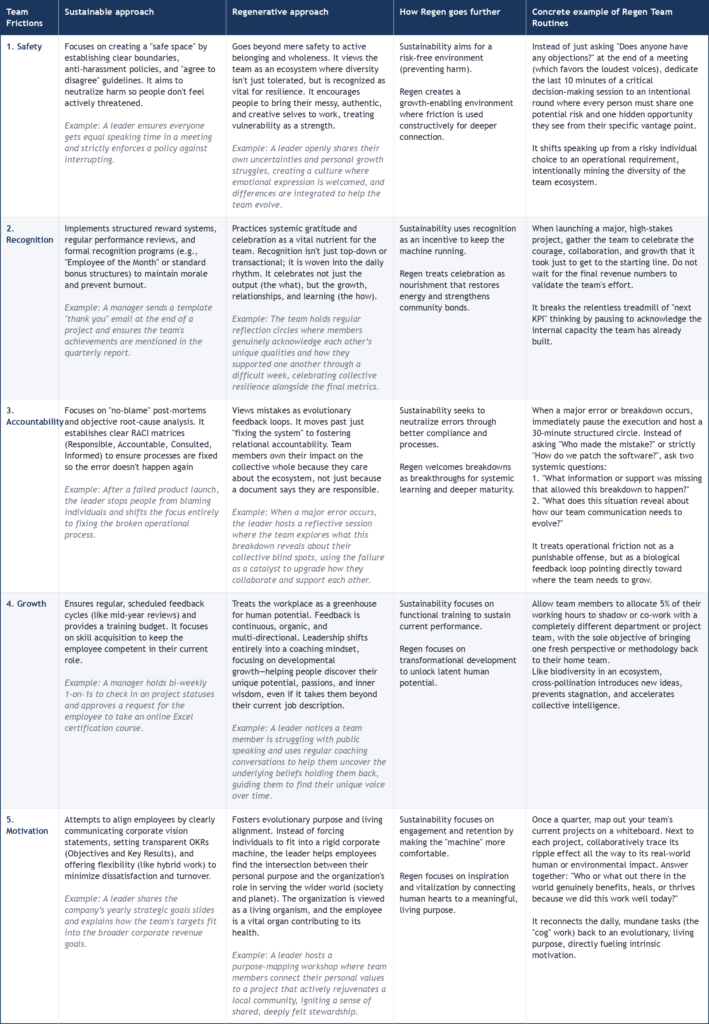
- Feel unsafe to speak up or be fully themselves; they mask their true identities and walk on eggshells due to a lack of psychological safety.
- Don’t feel recognized, don’t get credit, don’t celebrate successes. Milestones are bypassed in a relentless rush toward the next quarterly target.
- Feel there’s a blame culture and a lack of accountability; when things go wrong, fingers are pointed.
- Feel there’s no real feedback culture and don’t get many opportunities to develop or feel supported.
- Feel alienated, like a cog in the machine, disconnected from their organisation’s purpose.
For each of these 5 pain points, the table below describes the sustainable approach to ‘fixing’ the problem, what the regenerative ‘next level’ could look like, and — to keep things real – a concrete example of what regenerative team routines could look like on a daily basis.