Benelux

EN

After regen comes sunshine

JUMP TO SECTION

After Regen comes Sunshine

Written by Tom Van Dyck, Partner at TPC Leadership BeNeLux

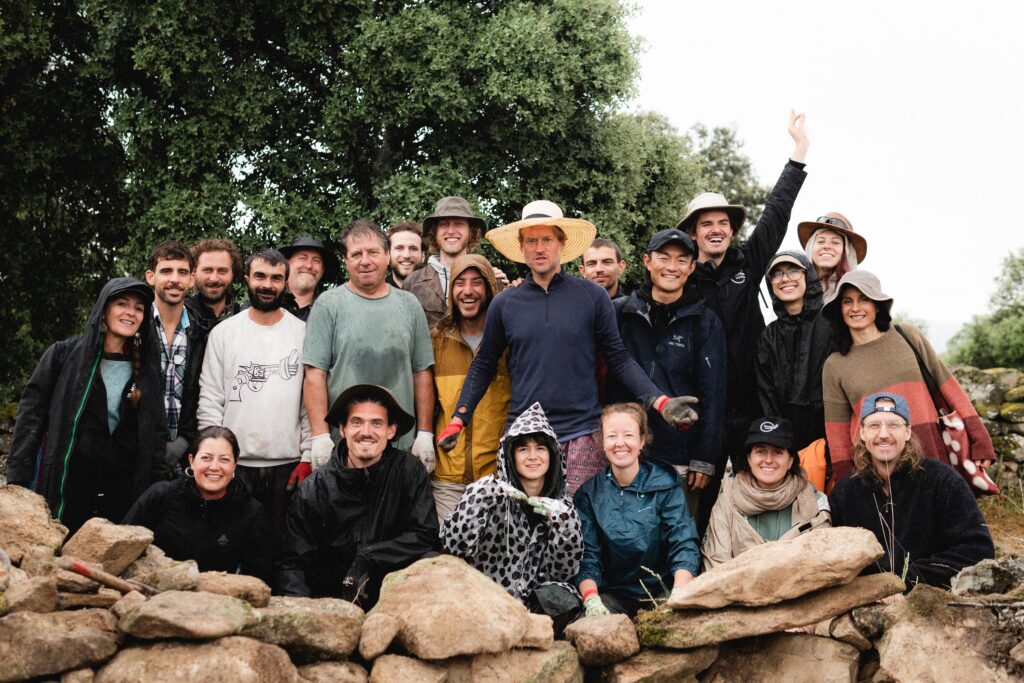
Earlier this Spring, I got involved with Ten Lives – a festival in Portugal that regenerates soil in Southern Europe, fighting desertification through music. The (brilliant) folks from Ten Lives do it with shovels and beats so that dry soil starts re-greening with more water, more trees, more biodiversity. Life returns. While out in the field delivering a leadership training for the group leads (called “Guardians”) of the festival , something sparked: could the same logic apply to how we lead teams?
With the wider acceptance that ‘sustainability’ alone may not be enough anymore, regeneration has been on our mind increasingly across various topics. It helped me connect some dots on many leadership topics we come across on an almost daily basis, serving as an invitation to reflect on how we could make things better again, instead of ‘not worse’.

And here’s the thing: we already do it. Some clients already do it. Many of our leadership interventions are regenerative by nature. We were just missing the language to pinpoint the impact of what we do.

Sustainability vs. Regeneration

For years now, ‘sustainability’ has been the go-to standard. ‘Do no harm’ – the idea that resources are finite and must not be depleted has luckily been gaining traction. Companies, executives, leaders everywhere are now increasingly striving to ‘not make things worse’ by running their business, by leading their teams. That is a commendable direction of travel…but is it enough? Just looking at the people/leadership arena…is it enough to…

  • Leave burnout and other mental health issues at current levels?
  • Leave disengagement levels where they are?
  • Leave the glass ceiling where it is?
  • Accept that x% of M&A and Transformation projects fail, at very high financial and human cost?

We can (some say ‘should‘) fix what is broken. We can move beyond Sustainability. We can move towards a logic where we leave things behind in a better place than how we found it: we can re-generate. Beyond the end result, is the process.

Regeneration heavily leans on systemic thinking, going beyond the individual and looking at connectivity and collective power. It recognizes that when things go well, it’s often thanks to the collective effort of many. And when things don’t go well, it’s often not one individual’s ‘fault’ – we need to look at relations between members, communication, and how the system itself is set up.

Today, people crave more social connection, more belonging, and simply feel better in their skin if they are part of something bigger. A regen mindset helps us move away from the era of heroic leadership and shift towards an era of social, meaningful impact.
Regeneration in Leadership, focus on Teams

We can make life return in leadership too; if it’s done right. Credit where credit is due: I first came across it in an article published by BCG, already back in 2022: ‘Generative leaders strive to leave the world a better place than they found it. With so much at stake, they are seizing a rare opportunity to do better not just for their shareholders, but for their customers, for their teams, for society, and for the planet as well.’

Here I’d like to zoom in on one particular stakeholder group: teams. Our favourite leadership playground. Our starting point. Our unit of focus. Teams are the arena of leadership – where things become real. Teams are where:

  • Individual leaders can finally apply what they learned in class. Like the sound of one hand clapping, leadership without people to be led is like operating in a vacuum. Things become real and messy in a social, collective context. Where we evolve from a ‘me’ to a ‘we’ sport.
  • Teams are the place where people interact, synergise, give & receive feedback, generate their best ideas, help each other grow — where they become a system that’s delivering more than the sum of the parts.
  • Teams are the place where culture is shaped. Teams do things in a certain way, have their ‘je ne sais quoi‘ that no-one inside notices, yet everyone outside does. Teams are the ‘cell’ of the organism.
  • People crave belongin, but the sheer size of organisations has become too big for people to identify with. People however can belong to their team. That’s their microcosm as a pars pro toto.

Structured approach: from a team's pain points to regenerative team routines

What’s broken? Referring to many of the conversations we have with current or future clients, there are some recurring themes. At team level, people often…

  • Feel unsafe to speak up or be fully themselves; they mask their true identities and walk on eggshells due to a lack of psychological safety.
  • Don’t feel recognized, don’t get credit, don’t celebrate successes. Milestones are bypassed in a relentless rush toward the next quarterly target.
  • Feel there’s a blame culture and a lack of accountability; when things go wrong, fingers are pointed.
  • Feel there’s no real feedback culture and don’t get many opportunities to develop or feel supported.
  • Feel alienated, like a cog in the machine, disconnected from their organisation’s purpose.

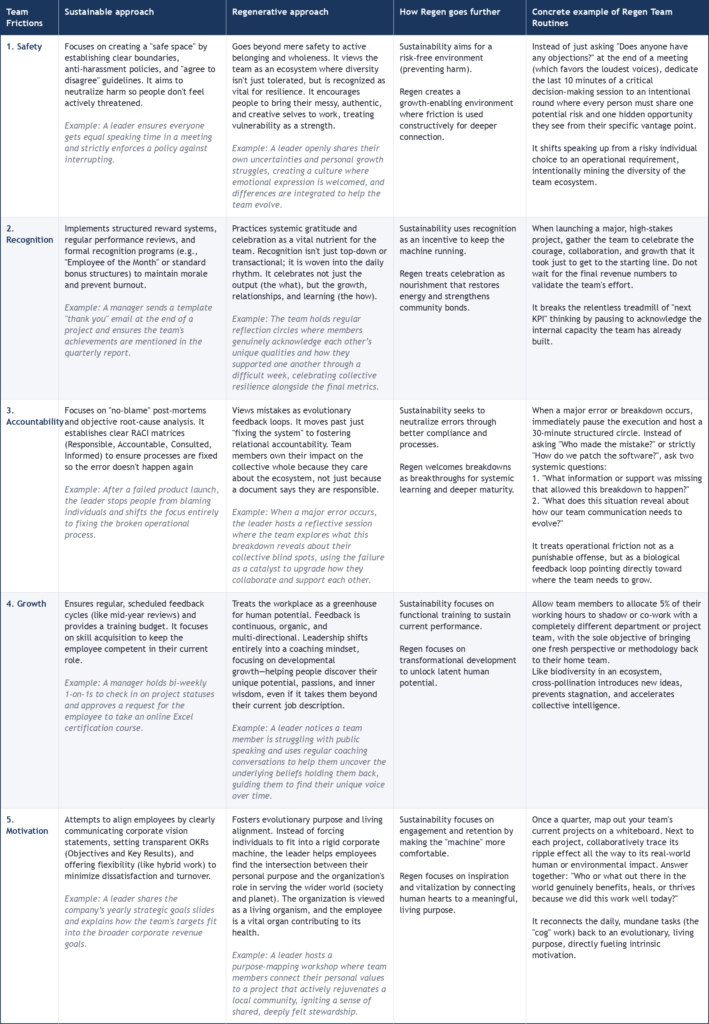
For each of these 5 pain points, the table below describes the sustainable approach to ‘fixing’ the problem, what the regenerative ‘next level’ could look like, and — to keep things real – a concrete example of what regenerative team routines could look like on a daily basis.
Team Friction

Sustainable Approach

Regenerative Approach

How Regen goes further

Concrete examples of Regen Team Routines

  1. Safety

Focuses on creating a “safe space” by establishing clear boundaries, anti-harassment policies, and “agree to disagree” guidelines. It aims to neutralize harm so people don’t feel actively threatened.

Example: A leader ensures everyone gets equal speaking time in a meeting and strictly enforces a policy against interrupting.

Goes beyond mere safety to active belonging and wholeness. It views the team as an ecosystem where diversity isn’t just tolerated, but is recognized as vital for resilience. It encourages people to bring their messy, authentic, and creative selves to work, treating vulnerability as a strength.

Example: A leader openly shares their own uncertainties and personal growth struggles, creating a culture where emotional expression is welcomed, and differences are integrated to help the team evolve.

Sustainability aims for a risk-free environment (preventing harm).

Regen creates a growth-enabling environment where friction is used constructively for deeper connection.

Instead of just asking “Does anyone have any objections?” at the end of a meeting (which favors the loudest voices), dedicate the last 10 minutes of a critical decision-making session to an intentional round where every person must share one potential risk and one hidden opportunity they see from their specific vantage point.

It shifts speaking up from a risky individual choice to an operational requirement, intentionally mining the diversity of the team ecosystem.

2. Recognition

Implements structured reward systems, regular performance reviews, and formal recognition programs (e.g., “Employee of the Month” or standard bonus structures) to maintain morale and prevent burnout.

Example: A manager sends a template “thank you” email at the end of a project and ensures the team’s achievements are mentioned in the quarterly report.

Practices systemic gratitude and celebration as a vital nutrient for the team. Recognition isn’t just top-down or transactional; it is woven into the daily rhythm. It celebrates not just the output (the what), but the growth, relationships, and learning (the how).

Example: The team holds regular reflection circles where members genuinely acknowledge each other’s unique qualities and how they supported one another through a difficult week, celebrating collective resilience alongside the final metrics.

Sustainability uses recognition as an incentive to keep the machine running.

Regen treats celebration as nourishment that restores energy and strengthens community bonds.

When launching a major, high-stakes project, gather the team to celebrate the courage, collaboration, and growth that it took just to get to the starting line. Do not wait for the final revenue numbers to validate the team’s effort.

It breaks the relentless treadmill of “next KPI” thinking by pausing to acknowledge the internal capacity the team has already built.

3. Accountability

Focuses on “no-blame” post-mortems and objective root-cause analysis. It establishes clear RACI matrices (Responsible, Accountable, Consulted, Informed) to ensure processes are fixed so the error doesn’t happen again

Example: After a failed product launch, the leader stops people from blaming individuals and shifts the focus entirely to fixing the broken operational process.

Views mistakes as evolutionary feedback loops. It moves past just “fixing the system” to fostering relational accountability. Team members own their impact on the collective whole because they care about the ecosystem, not just because a document says they are responsible.

 Example: When a major error occurs, the leader hosts a reflective session where the team explores what this breakdown reveals about their collective blind spots, using the failure as a catalyst to upgrade how they collaborate and support each other.

Sustainability seeks to neutralize errors through better compliance and processes.

Regen welcomes breakdowns as breakthroughs for systemic learning and deeper maturity.

When a major error or breakdown occurs, immediately pause the execution and host a 30-minute structured circle. Instead of asking “Who made the mistake?” or strictly “How do we patch the software?”, ask two systemic questions:

  1. “What information or support was missing that allowed this breakdown to happen?”
  2. “What does this situation reveal about how our team communication needs to evolve?”

 It treats operational friction not as a punishable offense, but as a biological feedback loop pointing directly toward where the team needs to grow.

4. Growth

Ensures regular, scheduled feedback cycles (like mid-year reviews) and provides a training budget. It focuses on skill acquisition to keep the employee competent in their current role.

 Example: A manager holds bi-weekly 1-on-1s to check in on project statuses and approves a request for the employee to take an online Excel certification course.

Treats the workplace as a greenhouse for human potential. Feedback is continuous, organic, and multi-directional. Leadership shifts entirely into a coaching mindset, focusing on developmental growth—helping people discover their unique potential, passions, and inner wisdom, even if it takes them beyond their current job description.

 Example: A leader notices a team member is struggling with public speaking and uses regular coaching conversations to help them uncover the underlying beliefs holding them back, guiding them to find their unique voice over time.

Sustainability focuses on functional training to sustain current performance.

Regen focuses on transformational development to unlock latent human potential.

Allow team members to allocate 5% of their working hours to shadow or co-work with a completely different department or project team, with the sole objective of bringing one fresh perspective or methodology back to their home team.

Like biodiversity in an ecosystem, cross-pollination introduces new ideas, prevents stagnation, and accelerates collective intelligence.

5. Motivation

Attempts to align employees by clearly communicating corporate vision statements, setting transparent OKRs (Objectives and Key Results), and offering flexibility (like hybrid work) to minimize dissatisfaction and turnover.

 Example: A leader shares the company’s yearly strategic goals slides and explains how the team’s targets fit into the broader corporate revenue goals.

Fosters evolutionary purpose and living alignment. Instead of forcing individuals to fit into a rigid corporate machine, the leader helps employees find the intersection between their personal purpose and the organization’s role in serving the wider world (society and planet). The organization is viewed as a living organism, and the employee is a vital organ contributing to its health.

 Example: A leader hosts a purpose-mapping workshop where team members connect their personal values to a project that actively rejuvenates a local community, igniting a sense of shared, deeply felt stewardship.

Sustainability focuses on engagement and retention by making the “machine” more comfortable.

Regen focuses on inspiration and vitalization by connecting human hearts to a meaningful, living purpose.

Once a quarter, map out your team’s current projects on a whiteboard. Next to each project, collaboratively trace its ripple effect all the way to its real-world human or environmental impact. Answer together: “Who or what out there in the world genuinely benefits, heals, or thrives because we did this work well today?” 

It reconnects the daily, mundane tasks (the “cog” work) back to an evolutionary, living purpose, directly fueling intrinsic motivation.

Why Regenerative Leadership is Harder, Not Softer

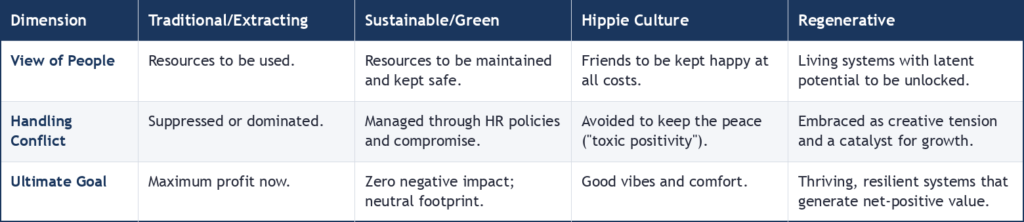
An often-heard criticism towards ‘regen’ could be that it feels a bit hippie, soft, wushy-washy, kumbaya. When people hear terms like “wholeness,” “living systems,” and “nourishment” in a corporate context, their corporate skepticism radar instantly goes off. However, far from being “soft,” true regenerative leadership is actually harder, more disciplined, and more rigorous than traditional or sustainable leadership.

  1. It is Rooted in Science, Not Mysticism

While the language can sometimes sound esoteric, regenerative leadership is based on systems thinking, complexity theory, and evolutionary biology. It recognizes that a business is not a machine (where you change a part and it works), but a living ecosystem (like a forest or the human body). When a leader treats a team like a living system, they stop applying superficial, short-term fixes and start addressing the root causes of systemic dysfunction.

  1. It Requires Extreme Accountability (Not “Soft” Leniency)

People often confuse a regenerative culture with an “anything goes” culture where performance doesn’t matter. In reality, it is the exact opposite. Regenerative accountability is relational and systemic — because team members are treated as vital parts of a whole, the expectation to perform and support the ecosystem is incredibly high. It requires radical maturity, deep self-awareness, and the courage to have incredibly difficult, honest conversations.

  1. It Drives Hard Financial and Operational Resilience

Regenerative practices are built specifically to survive when times are bad. Regenerative teams possess a level of agility that traditional teams lack: they don’t panic during market shifts, they adapt and evolve rapidly because they aren’t paralyzed by a fear of failure or a rigid corporate hierarchy. That is not a soft outcome,  it is a competitive advantage.
Dimension

Traditional/Extracting

Sustainable/Green

Hippie Culture

Regenerative

View of People

Resources to be used.

Resources to be maintained and kept safe.

Friends to be kept happy at all costs.

Living systems with latent potential to be unlocked.

Handling Conflict

Suppressed or dominated.

Managed through HR policies and compromise.

Avoided to keep the peace (“toxic positivity”).

Embraced as creative tension and a catalyst for growth.

Ultimate Goal

Maximum profit now.

Zero negative impact; neutral footprint.

Good vibes and comfort.

Thriving, resilient systems that generate net-positive value.


The “hippie” stigma exists because some organizations adopt the vocabulary of regenerativity without doing the structural work of changing how power, economics, and accountability operate. True regenerative leadership isn’t about making everyone feel comfortable and happy all the time. Nature isn’t always comfortable; it involves decay, storms, and intense adaptation. It’s not soft – it’s adaptive survival.

What's Next?

Recognise the pain points? We’d love to hear what you’ve tried, what works, and where you’re still searching.

In this article we haven’t gone deeply into some of the specific vocabulary of regenerative leadership, but it is a fascinating world that truly offers a language for phenomena we all recognise. If you’re interested in receiving our 10 Principles of Regenerative Leadership, contact us and we’d be happy to engage.

We don’t hold all the answers — but we trust that together with you, we can regenerate the workplace towards a better future.
Share this article:

Topics:

Tagged:

Read Next

Leadership at the edge: what the room taught us

Leadership at the edge: what the room taught us On the 24th of March, TPC Leadership Benelux and Polar Experiences brought together over 100 leaders at De Warande in Brussels

How full is your diamond?

How Full is your Diamond? The first half of the year has been incredibly full. As the summer approaches, many of us are arriving at the finish line stretched thin